About Salvia mexicana L.
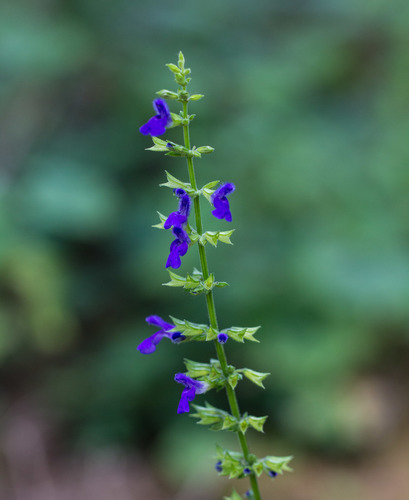
Salvia mexicana, commonly called Mexican sage, is a herbaceous shrubby perennial plant native to a broad region of central Mexico. It grows at elevations between 800 and 2,600 metres (equivalent to 2,600 to 8,500 feet), inhabiting tropical areas in the southern part of its range and arid subtropical habitats in the north, frequently growing at forest edges. When cultivated, Salvia mexicana reaches 0.9 to 2.7 metres (3 to 9 feet) in height and spreads 0.9 to 1.2 metres (3 to 4 feet) wide. Its leaves show variation, ranging from mid-green and glabrous to gray green with short hairs. Its inflorescences also vary in both length and flower size. The color of both flowers and their calyces ranges from midnight-purple to purple-blue. Flowers bloom in late summer, arranged in abundant whorls that continue to appear for several months. The earliest records of Salvia mexicana being used in horticulture date to the 1970s, when it was introduced at several botanical gardens. One popular cultivar is 'Limelight', which was collected in the Mexican state of Querétaro and bears violet-blue flowers with large chartreuse-green calyces. Two additional cultivars commonly sold at nurseries are 'Lollie Jackson', a compact variety, and 'Ocampo', an upright cultivar that grows to 2 metres (7 feet) tall.