About Salvia involucrata Cav.
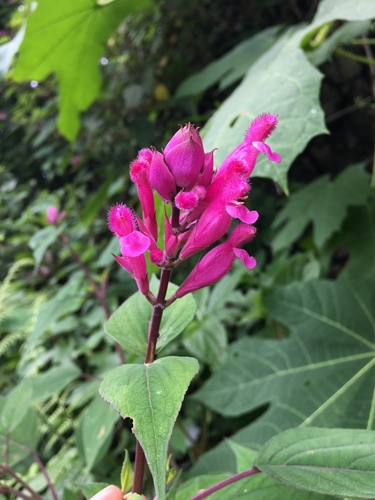
Salvia involucrata Cav. grows 1.5 m (5 ft) or taller before it begins blooming in late summer. Its flowers and bracts are a reddish beetroot color. Bracts grow in pairs, each enclosing three flowers, and fall away as the flowers open. The plant has small, flat, mid-green leaves that are slightly heart-shaped (cordate). Unusually, the leaf petioles and veins share the same beetroot-reddish hue as the flowers. Genetically, this species has 11 tetraploid chromosomes. The species and its cultivars 'Bethellii' and 'Boutin' have been awarded the Royal Horticultural Society's Award of Garden Merit. 'Bethellii' was introduced in 1881, valued for its compact growth habit and large ovoid leaves. Another cultivar, 'Deschamsiana', is common in France and Britain; it was selected in 1869 for the bright rose color of its inflated flowers. Cultivars popular in the U.S. include 'Hidalgo', 'El Butano', and 'El Cielo' — each named after the location in Mexico where it was originally collected. Salvia involucrata breeds freely with other Salvia species, producing many hybrids at the University of California Botanical Garden that display hybrid vigor. Some of these hybrids are known to grow up to six feet tall and have a longer blooming period. 'Mulberry Jam', a smaller hybrid with upright growth, stronger stems, and continuous blooming from summer until frost, was introduced in 1995 by Betsy Clebsch. When grown as a garden plant, Salvia involucrata prefers well-drained soil, half to three-quarters of a day of sunlight, humus-enriched soil, and deep weekly watering. It can be propagated by division or cuttings; cuttings can be rooted in late summer or early autumn. The plant regrows from the ground after light freezes, and should be pruned back to active nodes a few inches from the crown in early spring. Historically, Salvia involucrata and several other species in its genus have been used as a memory-enhancing remedy in traditional herbal medicine. Scientific studies conducted to confirm this use have found that extracts of Salvia involucrata (along with extracts of other Salvia species) contain significant levels of compounds relevant to the cerebral cortex, including compounds that have binding affinity for acetylcholine receptors. Salvia involucrata has also been used historically as an indicator of carbon dioxide metabolism. In a 1919 study, the species was used to investigate the effects of ether on the rate of CO2 respiration in dying cells. The study found that petals of Salvia involucrata immersed in ether consumed more oxygen as the cells died.