About Salvia hierosolymitana Boiss.
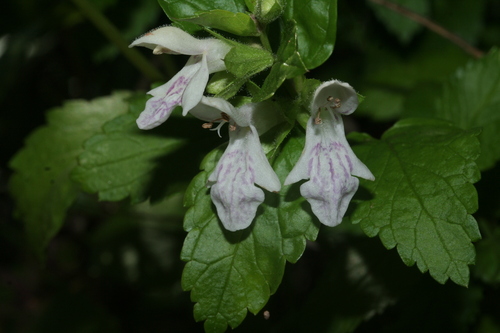
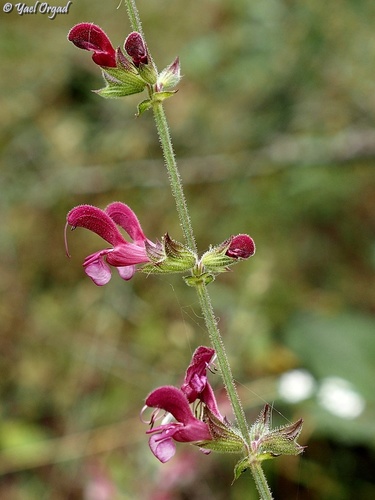
Salvia hierosolymitana Boiss. is a species of flowering plant in the family Lamiaceae. It is a herbaceous perennial commonly known as Jerusalem salvia or Jerusalem sage, native to the eastern Mediterranean, with confirmed populations in Cyprus, Israel, Jordan, Lebanon, Syria, and the West Bank. It typically grows in open fields, on rocky soils, and among low-growing native shrubs. This species was first described in 1853 by botanist Pierre Edmond Boissier; the specific epithet "hierosolymitana" refers to "royal, sacred Jerusalem". This plant forms a mound of basal leaves that spreads to 2 ft (0.6 m), and reaches a slightly shorter height. Its ovate mid-green leaves are evergreen, lightly covered with hairs, and have scalloped margins. Leaves grow 8–10 in (20–25 cm) long, with prominent veining on their underside. Flowers are 1 inch or smaller, wine-red in color, and grow in widely spaced whorls, with 2–6 flowers per whorl. The lower flower lip is white with wine-red spotting. Calyces are pea-green with red veins, and bracts are edged in red. The square stems of the 1 ft long inflorescences are also edged in red. Unlike many species in the Salvia genus, crushed leaves of Salvia hierosolymitana produce no odor, and there is no broadly recognized known medicinal use for this plant. In traditional folk herbal medicine of Jordan and Palestine, the plant is used to treat various ailments, and its seeds are prepared as a remedy for skin cancer.