About Salvia cuspidata Ruiz & Pav.
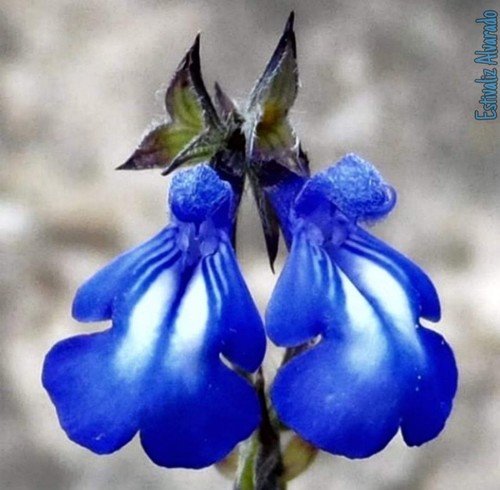
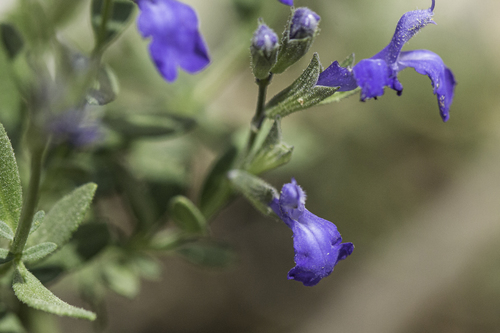
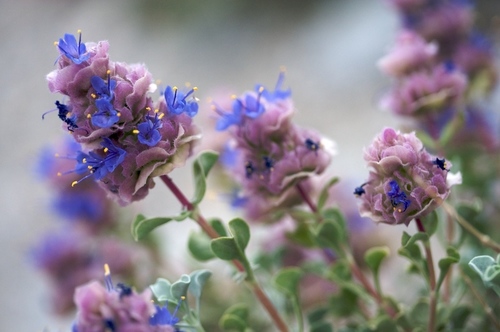
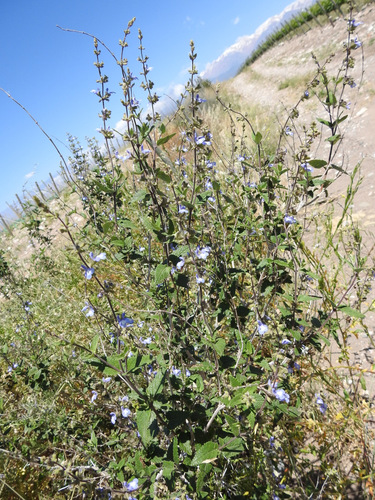
Salvia cuspidata Ruiz & Pav. is a species of perennial shrub that belongs to the Lamiaceae plant family. It is native to the Andes mountains of Bolivia, Chile, and Peru, where it grows at elevations up to 10,000 feet (3,000 meters). A subspecies, Salvia cuspidata subsp. gilliesii, was originally described and named Salvia gilliesii by George Bentham in 1873, before being reclassified as Salvia cuspidata subsp. gilliesii in 2007. Gardeners have only discovered this plant relatively recently; it has been grown and distributed on the French Riviera since 1994, and in the United States since 2002. In its native habitat, Salvia cuspidata subsp. gilliesii can grow up to 9 feet (2.7 meters) tall, reaching somewhat shorter heights when grown in cultivation. New stems that emerge in early spring are light green and square in cross-section, and quickly become rounded, woody, and soft gray in color. When many upright stems grow close together, the plant develops a tall, airy overall appearance. The plant produces lanceolate, serrated leaves that vary in graduated sizes, have white undersides with prominent veining, and are lightly distributed across the plant. Its branched inflorescences hold well-spaced whorls that each contain 3 to 6 flowers. The small flowers measure 0.75 inches (1.9 centimeters) long, and are a deep sky-blue color with a purple undertone. Each flower is held in a tiny calyx that is purple on the side facing the sun, and green on the underside. The flower's upper lip has a whitish powdery dusting, while the wider lower lip has two white lines that guide insects to the nectar.