About Salvia canescens C.A.Mey.
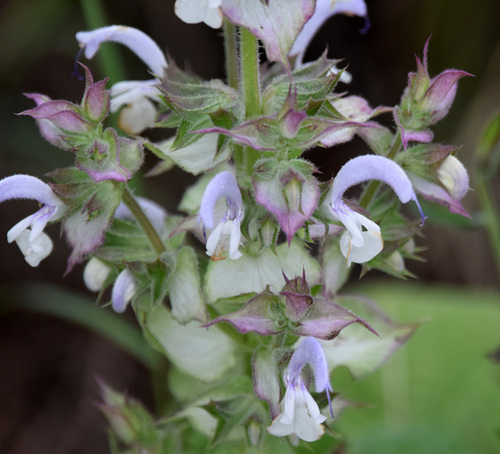
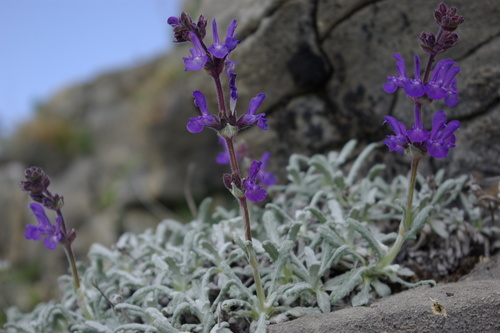
Salvia canescens, commonly called hoary sage, is a herbaceous perennial plant endemic to the Caucasus Mountains. Its specific epithet canescens refers to the off-white hairs that cover the plant’s leaves. This species was first formally described in 1831 by Russian botanist Carl Anton von Meyer. English botanist George Bentham later applied the same name to an unrelated species; he corrected this error in his 1833 work Labiatarum Genera et Species, reclassifying S. canescens Benth. as a synonym of Salvia pallida. In 1992, Russian botanist Y. L. Menitsky reclassified Salvia daghestanica, a species originally described in 1951 by Dmitrii Ivanovich Sosnowsky, as a variety of S. canescens. This taxonomic change required creation of the autonym S. canescens var. canescens for the original variety. Salvia canescens var. daghestanica grows to nearly 1 foot (0.30 meters) in both height and width, forming a compact mound. It produces snow-white leaves measuring 1 to 4 inches (2.5 to 10.2 cm) long, which are covered with white hairs on both the upper and lower surfaces. The variety bears royal purple flowers arranged in whorls, which bloom in summer and again in autumn. Individual flowers reach just over 0.5 inches (1.3 cm) in length and have a small calyx. The flower-bearing inflorescences grow up to 1 foot (0.30 meters) long, holding the blooms above the plant’s foliage.