About Salvia brandegeei Munz
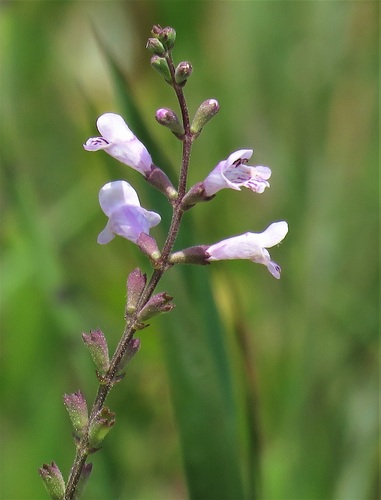
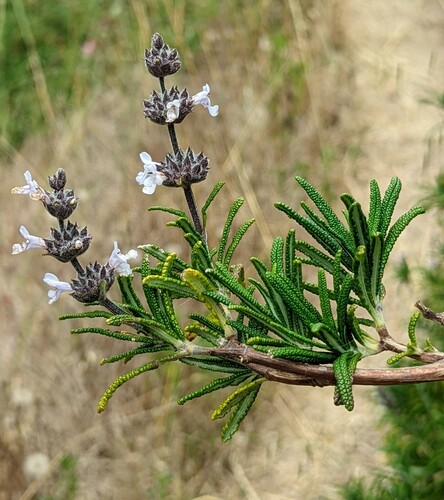
Salvia brandegeei Munz is a shrub species that typically grows either more than 1 meter tall or in a prostrate form. This species is heterostylous, and the trichomes (hairs) covering it are branched. Its dark green leaves are 2 to 6 cm long, with blades shaped from linear to linear-elliptic. The upper (adaxial) surface of each leaf is glabrous, while the lower (abaxial) surface is densely covered in white hairs. Leaf margins are rolled under and bear small, rounded, scalloped teeth. The plant produces pale lavender to pale blue flowers arranged in tightly spaced whorls. The violet-gray calyx, paired with wide open flower lips, makes the flowers very showy. Inflorescence clusters measure 1.5 to 2 cm wide, with ovate bracts that have sharp tips. The flower's calyx is 7 to 8 mm long, covered in long hairs, and its upper lip is minutely 3-lobed. The corolla tube is 7 to 8 mm long; the upper corolla lip is 3 to 3.5 mm long, and the lower corolla lip is 3 to 4 mm long. Stamens are more or less included, meaning they do not project beyond the mouth of the corolla. This species is distributed on Santa Rosa Island, California, where it is widespread and even co-dominant in numerous large, healthy populations growing in island shrubland. It also occurs along a 40-mile strip of immediate coast in Baja California, ranging from the vicinity of Ensenada south to San Quintin, where it grows in maritime succulent scrub and chaparral habitats. In cultivation, the plant reaches 4–5 feet tall and up to 7 feet (2.1 m) wide. It prefers full sun and dry growing conditions, and grows well in both sandy and clay soils. It can tolerate temperatures as low as 0 °F for several hours.