About Salvelinus malma (Walbaum, 1792)
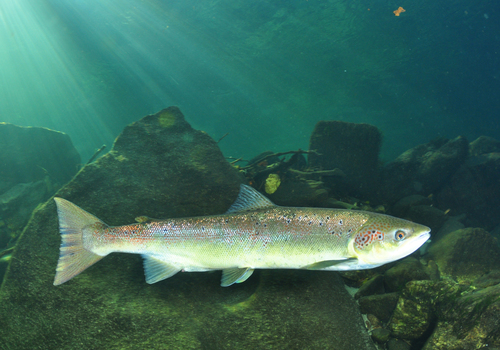
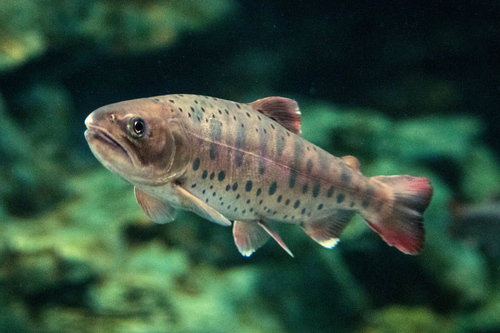
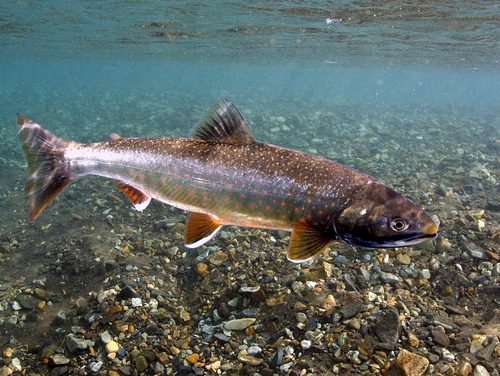
Salvelinus malma, commonly known as the Dolly Varden trout, has an olive green or muddy gray back and sides that shade to white on the belly. Its body has scattered pale yellow or pinkish-yellow spots, with no black spots or wavy lines present on either the body or fins. Small red spots appear on the lower sides of the body, and these spots are frequently indistinct. All fins are plain and unmarked, with the exception of a few light spots on the base of the caudal fin rays. S. malma is extremely similar in appearance to the bull trout (S. confluentus) and Arctic char (S. alpinus), so much so that the three are sometimes grouped together and called "native char" without distinction. The Dolly Varden trout is found in coastal North Pacific waters, ranging from Puget Sound north along the British Columbia Coast to the Alaska Peninsula, and extending into the eastern Aleutian Islands. It also occurs along the Bering Sea and Arctic Sea coasts as far as the Mackenzie River. In Asia, its range extends south through the Kamchatka Peninsula into northern Japan. Dolly Varden trout occur in three distinct life cycle forms. The semi-anadromous or sea-run form migrates out of fresh water to spend time feeding in the ocean or saltwater bays and estuaries, before returning to fresh water to spawn. Fluvial forms live in moderate to large freshwater river environments, and migrate into smaller tributaries to spawn. The third form lives in deep, cold lakes, and eventually migrates into tributary streams to spawn. Most populations of the northern subspecies S. m. malma are semi-anadromous, while the southern subspecies S. m. lordi has more fluvial and lacustrine populations.