About Salvelinus fontinalis (Mitchill, 1814)
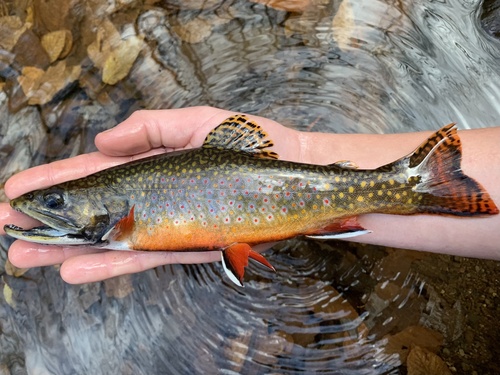
The scientific name of brook trout is Salvelinus fontinalis (Mitchill, 1814). Brook trout have a dark green to brown base color, with a distinctive lighter marbled pattern called vermiculation that covers their flanks, back, at least the dorsal fin, and often the tail. A distinct sprinkling of red dots surrounded by blue halos appears along their flanks. Their belly and lower fins are reddish, and the lower fins have white leading edges. During spawning, the bellies of brook trout, especially males, often turn very bright red or orange.
Typical brook trout range from 25 to 65 cm (9.8 to 25.6 in) in length, and weigh 0.3 to 3 kg (11 oz to 6 lb 10 oz). The maximum recorded length for the species is 86 cm (34 in), and the maximum recorded weight is 6.6 kg (14 lb 9 oz). Brook trout can live to at least seven years old, and 15-year-old individuals have been recorded in introduced habitats in California. Their growth rate depends on season, age, water and ambient air temperatures, and flow rates. In general, flow rate changes how temperature relates to growth rate: for example, in spring, growth increases with temperature much faster when flow rates are high than when they are low.
Brook trout are native to a large area of Eastern North America. Currently, their range is increasingly restricted to higher elevations in the southern part of their native range, extending southward through the Appalachian Mountains to northern Georgia and northwest South Carolina. Their native range also includes Canada east of the Hudson Bay basin, the Great Lakes–Saint Lawrence system, Canada's maritime provinces, and the upper Mississippi River drainage as far west as eastern Iowa. Habitat loss and the introduction of brown and rainbow trout have drastically reduced the southern portion of the species' historic native range, leaving brook trout only in higher-elevation, remote streams.
As early as 1850, human-assisted introductions allowed brook trout to expand westward from their native range. During the late 19th and early 20th centuries, brook trout were eventually introduced to suitable habitats across the western United States, at the request of the American Acclimatization Society and by private, state, and federal fisheries management authorities. Acclimatization efforts in Europe, South America, and Oceania led to brook trout being introduced across Europe, to Argentina, and to New Zealand. While not all introductions succeeded, many established wild, self-sustaining populations in non-native waters.
Brook trout inhabit large and small lakes, rivers, streams, creeks, and spring ponds in cold temperate climates with mild precipitation. Clear spring water with adequate cover and moderate flow rates supports strong, healthy brook trout populations. The species is highly adaptable to habitat changes caused by environmental factors, and has been observed to be more resilient to habitat change than other Salvelinus species. Brook trout typically occupy waters with a pH between 5.0 and 7.5, and can survive extreme pH values ranging from 3.5 to 9.8. Water temperatures in their typical habitat range from 1 to 22 °C (34 to 72 °F). Warm summer temperatures and low flow rates create stress for brook trout populations, particularly for larger individuals.
For reproduction, a female brook trout digs a depression called a redd in the stream bed, in a spot where groundwater moves upward through the gravel. One or more males approach the female, and fertilize the eggs as the female releases them. Most spawning events involve additional peripheral males, which directly affects how many eggs survive to adulthood. In general, the more peripheral males present, the more likely eggs are to be cannibalized. Brook trout eggs are slightly denser than water. After releasing eggs, the female covers and buries them in a small gravel mound, where they hatch after 4 to 6 weeks.
A female brook trout can deposit up to 5,000 eggs in gravel beds, after which the eggs enter an incubation period from winter to early spring. During incubation, eggs get oxygen from stream water that filters through the gravel and into their gel-like egg shells. After incubation, the eggs hatch into miniature fry that get nutrients from their yolk sac, as parent trout provide no nutrients during early development. In the next stage of the life cycle, fry hide from predators in rock crevices and inlets. While hiding, they mature into fingerlings by summer and develop parr marks that help with camouflage. At this stage, most brook trout are between 2 and 3 inches long. In the following months, the trout mature fully into adults that reach approximately 10 to 34 inches in length, and are able to spawn in fall. Fully developed adult brook trout have a vibrant olive-green back, cherry red underbelly, black-accented fins, and wavy dorsal patterns. A typical adult brook trout lives 3 to 4 years, and some individuals live longer than 4 years.