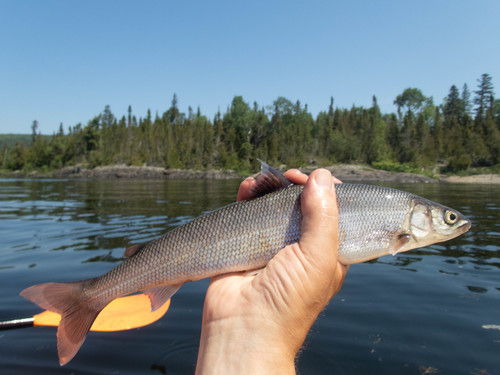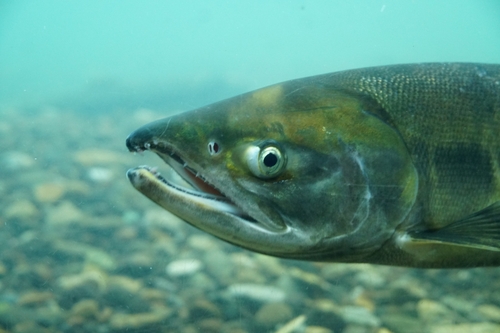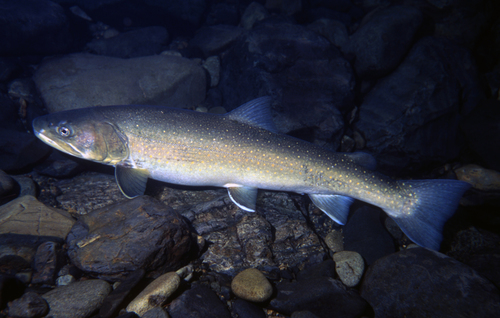
About Salvelinus confluentus (Suckley, 1859)
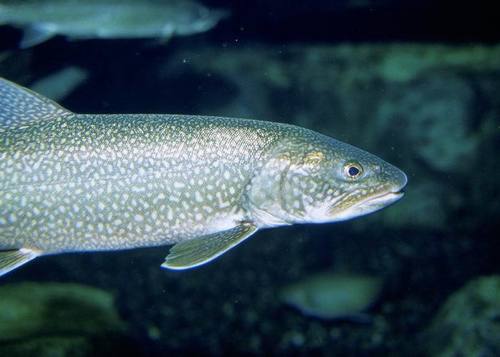
Like other char species, bull trout (Salvelinus confluentus) have white leading edges on all their fins. Compared to other salmonids, this species has an unusually large head and mouth, which is how it got its common name. Recorded specimens have reached up to 103 cm (41 inches) in length and 14.5 kg (32 pounds) in weight. Bull trout follow one of two life history patterns: migratory individuals move through large river systems, lakes, and even the ocean, while resident individuals stay in the same stream for their entire lives. Migratory bull trout are typically much larger than resident ones; resident bull trout rarely grow larger than 2 kg (4.4 lb). This species can be told apart from brook trout (S. fontinalis) by the lack of distinct spots on its dorsal fin, and by having yellow, orange, or salmon-colored spots on its back. Brook trout, by contrast, have red spots with blue halos on their backs. Bull trout also lack the deeply forked tail fin that identifies another char species, lake trout (S. namaycush). Salvelinus confluentus lives in cold, clear waters in the high mountains and coastal rivers of northwestern North America. Its confirmed range includes Yukon, Alberta, British Columbia, Washington, Oregon, Idaho, western Montana, and the Jarbidge River of northern Nevada, and it may also be present in Alaska. A population of bull trout lives east of the Continental Divide in Alberta, where it is the official provincial fish. Historically, bull trout's range also extended into northern California, but the species is now likely extirpated there. Bull trout have very specific habitat requirements: they need water temperatures generally below 13 °C (55 °F), clean gravel beds, deep pools, complex cover such as snags and cut banks, and large interconnected waterway systems to support spawning migrations. Because of these requirements, they most often occupy deep pools of cold lakes and large rivers, as well as high, cold mountain headwaters. Bull trout may be anadromous in coastal rivers, and individual bull trout have been recorded migrating from one coastal river to another via the ocean. The name "Dolly Varden" is also used for two other subspecies of Salvelinus malma: S. m. krascheninnikova, and S. m. miyabei, which is found in Lake Shikaribetsu on the Japanese island of Hokkaidō. The name "Dolly Varden" has also been applied to S. alpinus, which is now more commonly known as Arctic char.