About Salvator merianae Duméril & Bibron, 1839
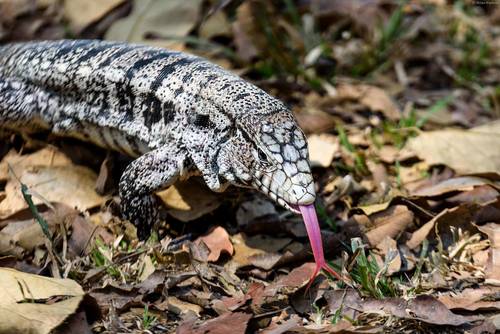
Salvator merianae (Duméril & Bibron, 1839), also known as the Argentine black and white tegu, is a large South American tegu lizard that has become an invasive species in parts of the United States. This species displays clear age-related changes in coloration and patterning. Hatchlings have emerald green color from the snout tip to the midpoint of the neck, marked with black; this green darkens to black within several months after a shed. Young individuals have yellow and black banded tails; as they age, the solid yellow bands closest to the body become weakly speckled, so older animals have fewer solid colored bands. Like many lizards, tegus can autotomize (drop) a section of their tail to distract attacking predators, and they also use their tails as sweeping weapons against threats. In the wild, this species has a lifespan of 12 to 15 years; under excellent captive care, individuals can live over 20 years. Tegus can run at high speeds, and can run bipedally for short distances. They often use bipedal running during territorial defense, holding their mouths open and front legs wide to appear more threatening. Adult males are much larger than females. Males reach 3 feet (91 cm) in total length (including the tail) at maturity, and may continue growing to a total length of 4–4.5 feet (120–140 cm). Females grow no larger than 3 feet (91 cm) in total nose-to-tail length, have beaded skin and longitudinal stripes running down their body, and reach an adult weight of 2.5–7.0 kg (5.5–15.4 lb). The species has a heavily built skull, with a large facial process of the maxilla, a single premaxilla, paired nasals, a single frontal bone, and two parietal bones separated by the sagittal suture. Biomechanical analyses suggest the posterior processes of the parietal may be important for handling torsional loads generated by unilateral posterior biting. In large adult individuals, the posterior teeth are larger and more rounded than the anterior teeth. Salvator merianae, previously classified under the name Tupinambis merianae, is native to South America; as its common name implies, it is native to Argentina, and also occurs naturally in Brazil, Paraguay, Bolivia, and Uruguay. Significant introduced populations exist in the southern United States and along the Brazilian coast. It is a well-documented problematic invasive species in Florida and Georgia, with additional sightings recorded in South Carolina. These introduced populations most likely originated from escaped or released pet specimens from the early 2000s pet trade. Research has found that differing weather and climate conditions outside the species' native range do not prevent adult Argentine black and white tegus from surviving in diverse areas across the United States, increasing concerns about their invasive potential. In their native range, wild tegus inhabit both forested and open plain environments, which expands their potential invasive range. The first confirmed reproducing population in southeastern Florida was documented when a tracked female was located at her nest mound; researchers found one current clutch of 21 eggs, and one past year clutch containing 22 hatched eggshells and 13 unhatched eggs. Established invasive communities have been identified in Hillsborough and Polk Counties, Florida. Tegus can also be found in scrub and wet habitats, including flooded savannas, canals, ponds, and streams. They generally do not discriminate between habitat types, as long as the environment allows them to burrow. Argentine black and white tegu eggs typically hatch at the start of spring. Each hatchling weighs approximately 10 g (0.35 oz), and grows to 8 kg (18 lb) within four to five years — a nearly 800-fold increase in body mass. Over this growth period, their diet shifts from insects to small vertebrates, eggs, carrion, and fruits. They reach reproductive maturity by their third year, at a weight of around 1.5 kg (3.3 lb), and stop growing by approximately their fourth year. The highest growth rate occurs during the first and second years of life. S. merianae has a seasonal activity cycle that develops within its first year: individuals are highly active during hotter months, and enter brumation during colder months. Unlike other endotherms, this species does not experience significant fluctuations in metabolism or body mass across seasons, so the temperature sensitivity of its metabolic rate does not alter body mass. This trait helps explain the species' alternating endothermic and ectothermic behavior. During embryonic development, brain vesicles (formed from two neural tube constrictions) that make up the anterior forebrain, midbrain, and posterior hindbrain are fully developed and distinguishable by day three of development. On day four, visceral arches (formed from mesenchymal tissue condensation and separated by grooves) begin to form, and are fully grown and fused by day nine. Day four also marks the first appearance of limbs as small swellings. The species' hindlimb development, where claws develop faster than on the forelimb, is more similar to crocodile or turtle embryonic development than to that of other lizards, which aligns with the greater functionality of hindlimbs in adult tegus. Pigmentation is the last morphological structure to develop, forming late after other distinguishing traits (such as scales) are already present. Pigmentation is first observed on day 39, starting on the dorsal portion of the head and body. It extends to the proximal and distal portions of the limbs by day 45, and extends down to the flanks by day 48. As development progresses, the pattern develops lateral stretch marks by day 51. Pigmentation of the ventral body occurs between days 57 and 60, and forms individualized spot patterns. Paired genital tubercles develop in both sexes; in males, these become hemipenes. Reptile embryo development proceeds through two separate processes: differentiation and embryo growth. Differentiation, defined by external morphological features, occurs early. As embryos approach hatching, development stages are grouped into periods based on development speed rather than chronological age. Like most squamate reptiles (lizards and snakes), S. merianae uses chemical cues to search for potential mates. Studies of skin lipids show that chemical cues can be used to alter the movement of invasive tegus in their non-native range, which may be useful for invasive species management. Argentine black and white tegus show characteristic pausing and turning behavior while following scent trails in spring. Females display stronger trailing behavior than males: they follow scent trails more intensely, have a more sensitive response to mating-specific chemical odors, and exhibit more decisive movement. This matches a common vertebrate pattern where female reproductive activity is the key factor influencing population size. Researchers are currently exploring knowledge of this scent-trailing behavior to develop strategies to slow the spread of invasive tegus; prioritizing removal of female tegus from invaded environments may be a more effective way to reduce invasive populations. Tegus are a burrowing species in both native and invaded habitats, particularly during winter. They mate in spring after emerging from hibernation, when their mating hormone levels are at their peak. During spring, males perform scent-marking behavior to delineate territory with gland secretions. Like other tegus, Argentine black and white tegus may breed up to twice per year. A clutch contains 18 to 25 eggs, and may sometimes hold more; clutch size depends on the adult female's size, individual health, and (for captive individuals) husbandry conditions. During the breeding season, females build nests from dry grass, small branches, and leaves to maintain optimal egg temperature and humidity. Egg incubation lasts an average of 64 days, with a total range of 40 to 75 days, varying with incubation temperature and other external factors. In its native range, S. merianae is commonly hunted as bushmeat for human consumption. Wider use of the species as a meat source could provide economic and dietary benefits.