About Salsola tragus L.
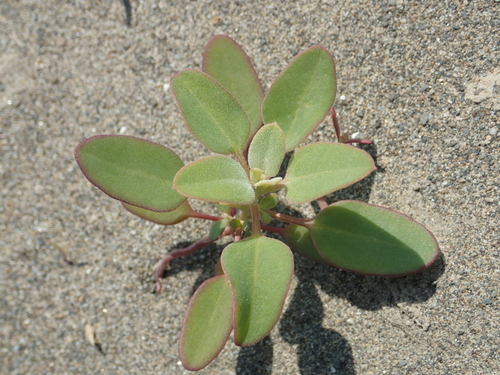
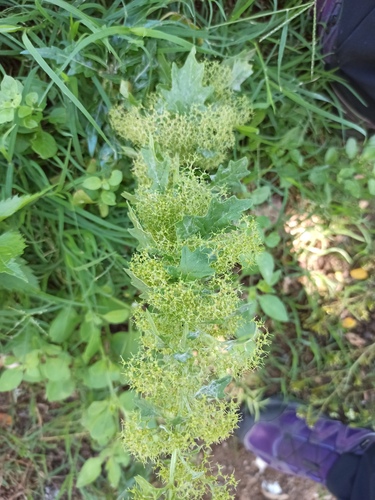
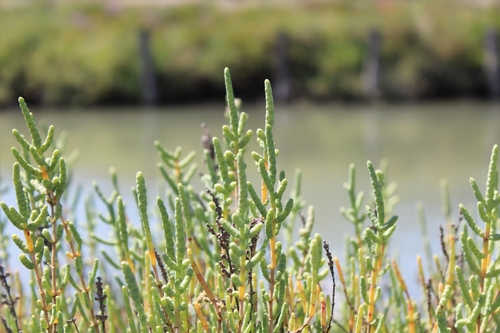
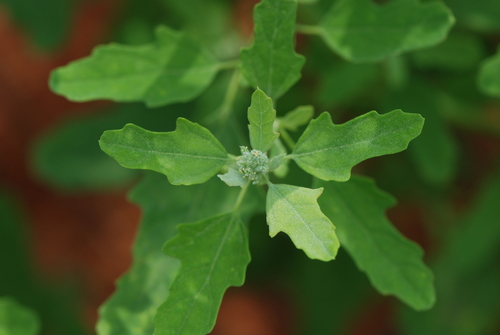
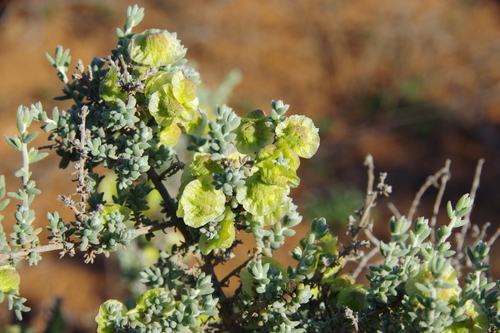
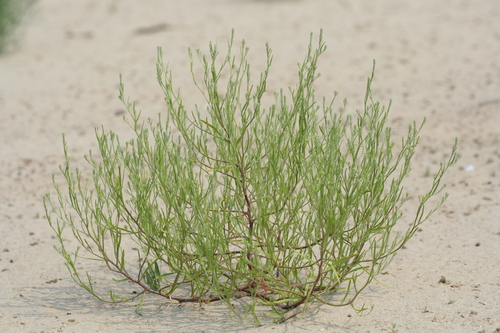
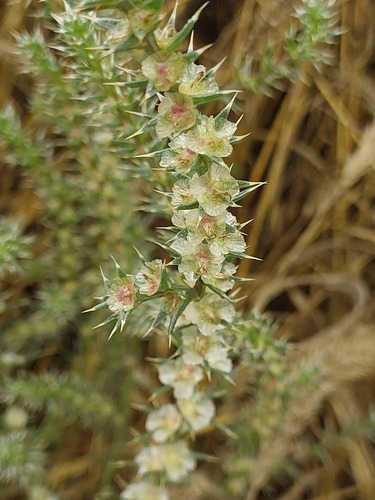
Salsola tragus L. is an annual forb. Young plants grow erect, before developing into a rounded clump of branched, tangled stems, each reaching up to around one metre in length. Leaf and stem color can be green, red, or striped, and surfaces may be hairless or pubescent, depending on the plant’s genetics and growing condition. All leaves are tipped with structures: most varieties have sharp spines, so the plants should be handled with gloves and other protective clothing, but some genetic variants only have a hair at the leaf tip. Juvenile leaves on young plants are succulent, roughly cylindrical, and can grow more than 5 cm long; these juvenile leaves are deciduous and drop as the plant matures. Mature plant leaves are persistent, leathery, broader and shorter than juvenile leaves, rarely growing over 1 cm long. They are rigid and spine-tipped, and remain on the stem until the plant dies at the end of the growing season. In the axil of each mature leaf, two leaf-like bracts grow with a single flower between them. The flower has no petals, and is surrounded by a disk of wide, winged sepals that range in color from whitish to pink.
As fruits develop, the plant becomes woody. When the fruits ripen, the plant begins to die, drying out and becoming brittle. In this dry brittle state, the base of the stem breaks off easily, especially in high wind. The broken plant then rolls easily in the wind as a tumbleweed, dispersing its seeds as it travels. A large Salsola tragus specimen can produce as many as 200,000 seeds.
Salsola tragus is a ruderal annual forb. It germinates quickly, even with very little moisture in arid conditions. Young plants may be grazed freely, but this edible grazing phase only lasts a short period, and generally occurs when other forage is already relatively plentiful. After this phase, it becomes a weed in most contexts. One factor driving this weed status is that most varieties become too spiny and woody for most livestock to browse as they mature. Older foliage also develops higher levels of oxalates, bitter tannins, and alkaloids that make it unpalatable. As fruits mature, the plant dies, dries, and becomes hard and brittle. It is in this state that it is most likely to detach from its root and become a tumbleweed. Compared to other tumbleweeds, it is very large, often reaching one metre or more in diameter. It is spiny, largely inedible to most livestock without processing, and acts as a fire hazard. However, in regions with plentiful winter rain, moisture softens its twigs and spines, after which hardy livestock breeds and some wildlife species will eat it again.
Salsola tragus has a bad reputation due to its spininess, mature woodiness, strong ecological competitiveness, and tumbleweed dispersal that lets it spread rapidly across open ground. Prince Gallitzin reported that during his journey out of his native Russia, he passed through southwest Siberia and found the Imperial government’s irrigation project abandoned and farms deserted, as a result of infestation by this species (then referred to as K. tragus). Oryol Oblast and Kyiv Oblast were also noted as particularly heavily infested. Over the past century or more, most publications on this species have discussed its harmful nature, the increasing threats it poses, and methods to control its invasiveness, and have largely ignored its other attributes. Even early publications conceded, however, that the plant is valuable as forage in severely arid conditions where few other forage species can grow. While most authors emphasize its harmful competitiveness as an invasive species, some have noted its value in regenerating overgrazed or otherwise degraded land.
Apart from its use for domestic cattle and sheep in some regions, Salsola tragus provides food and shelter for multiple wildlife species. It has high nutritional value, and is rich in various minerals, Vitamin A, and phosphorus. It is a minor forage source for bison, mule deer, and wapiti. Pronghorn eat it reluctantly during drought conditions, but feed on it eagerly when conditions are rainy, especially in wet years. Prairie dogs consume it as a major food source wherever they encounter it. Seed-eating birds and small mammals like rodents feed on its seeds. Salsola tragus also provides shelter for wildlife. Medium-sized deer species use it to some degree, but it is mainly valuable to small mammals and ground-dwelling bird species that shelter under low bushes. Some livestock species, including camels and breeds adapted to semi-desert conditions, will tolerate its spines to eat it when other forage is scarce. Many goats and some sheep breeds such as karakul browse this shrub. Like many other members of the Amaranthaceae, Salsola tragus is rich in high-quality proteins with a good balance of essential amino acids; its seeds have even higher protein content.
Oxalic acid is present in a wide range of plants, including Salsola tragus, as an adaptation to alkaline, relatively dry soils rich in calcite, gypsum, alumina, and/or other metal ions. Oxalic acid forms highly insoluble salts with calcium, aluminum, chromium, copper, lead, and many other transition metals. It is produced in specialized parenchyma cells called idioblasts. Inside these cells, oxalic acid binds with excess calcium from plant tissue to form needle-shaped crystals of calcium oxalate monohydrate called raphides. Calcium and other metal ions are sequestered in idioblast cells, which reduces their negative impact on the rest of the plant’s tissues. Raphides also act as a deterrent to insect predators, as the sharp crystals damage an insect’s digestive tract.
Salsola tragus and many related species, including some widely considered invasive weeds in other countries, are valued in their native regions. They are adapted to inhospitable environments that do not support many other forage species. For example, in Uzbekistan, the stems, fruits, and leaves of Salsola tragus are nutritious year-round feed for camels; sheep and goats prefer it in summer, and will also eat it to some degree in autumn and winter. Its fruits are important for fattening camels, goats, and karakul sheep, and can partially substitute for concentrate feeds, especially in autumn and winter. In these regions, annual Salsola species are called "solyanki". They are important drought- and salt-tolerant forage plants, and form a dominant component of the flora and vegetation of the region’s most challenging environments. Some species are useful for stabilising shifting sands and rehabilitating degraded rangelands, such as the saline soils of Kyzyl Kum’s red desert. Some of these species also invade ruderal sites or grow as weeds in cultivated fields. Although Salsola tragus has not gained much recognition in modern first-world livestock nutrition, this may reflect lost institutional knowledge rather than a lack of evidence for its benefits; during the North American Dust Bowl era, it was credited with saving the region’s beef cattle industry. When conventional hay crops failed and no other feed sources were available, farmers fed tumbleweed to their cattle.