About Salmo trutta Linnaeus, 1758
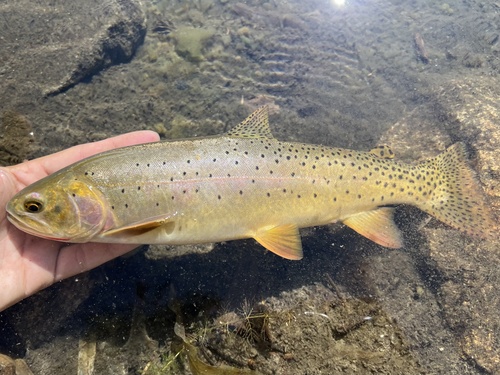
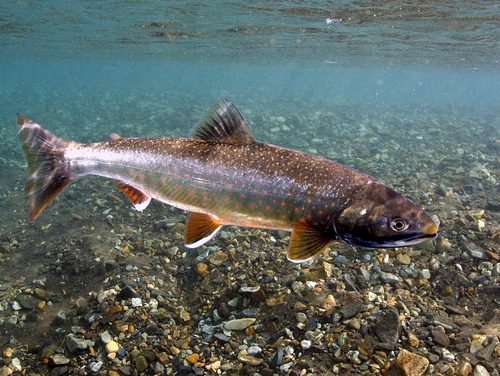
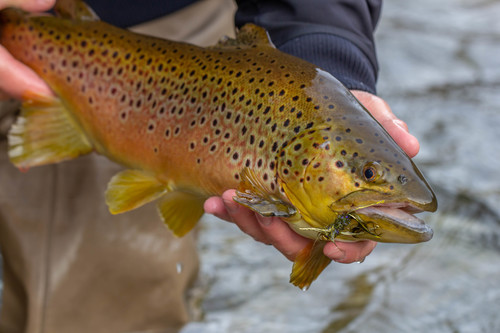
Salmo trutta (brown trout), first described by Linnaeus in 1758, has several defining physical characteristics. It has a slender body with a long, narrow head, a large mouth, and vomerine teeth arranged in a zig-zag pattern on the roof of the mouth. Its caudal fin is delta-shaped and unforked, which differs from the forked caudal fin of the related Atlantic salmon (Salmo salar). Dark and red spots are usually present on the sides of the body, and these spots do not extend onto the tail. Juvenile parr trout often have a red margin on the adipose fin, plus dark blotches along the sides that become less noticeable as the fish ages. Freshwater brown trout show wide color variation: they can be mostly silver with relatively few spots and a white belly, or the more familiar brassy reddish-brown that fades to creamy white on the belly, with medium-sized spots surrounded by lighter halos. More silver-colored brown trout are often mistaken for rainbow trout. There are distinct regional variants of the species: the "Loch Leven" trout has larger fins, a slimmer body, and heavy black spotting, with no red spots; the continental European strain has a lighter golden body tone, some red spotting, and fewer dark spots. Both strains still show substantial individual variation that can deviate from these general descriptions. Early stocking efforts in the United States sourced brown trout from Scotland and Germany. Brown trout are a medium-sized fish. In some locations, they can grow to 20 kg (44 lb) or more, reaching around 100 cm (39 in) in length; however, mature individuals in many smaller rivers commonly weigh 1.0 kg (2.2 lb) or less. The lacustrine subspecies S. t. lacustris has an average length of 40–80 cm (16–31 in), with a recorded maximum length of 140 cm (55 in) and maximum weight of about 27 kg (60 lb). Multiple official world records exist for the species: on September 11, 2009, Tom Healy caught an 18.80-kg (41.45-lb) brown trout in Michigan's Manistee River system, which was confirmed as the new all-tackle world record by both the International Game Fish Association and the Fresh Water Fishing Hall of Fame by the end of 2009, replacing the previous record from Arkansas' Little Red River. This 2009 record was later broken by a 20.1-kilogram (44 lb) specimen caught in the Ohau Canal in Twizel, New Zealand on October 27, 2020. The current IGFA all-tackle length world record is a 97-centimetre (38 in) fish caught in Milwaukee Harbor, Wisconsin on December 16, 2011. The spawning behavior of brown trout is similar to that of the closely related Atlantic salmon. A typical female brown trout produces around 2,000 eggs per kilogram (900 eggs per pound) of body weight when it spawns. Brown trout can live up to 20 years. As with Atlantic salmon, a high proportion of males die after spawning, and probably fewer than 20% of anadromous female kelts recover from spawning. Migratory forms of brown trout grow significantly larger at the same age compared to non-migratory forms, because the waters where they spend most of their lives have abundant forage fish. In nutrient-poor rivers, sea trout (the anadromous form of brown trout) are more commonly female. Brown trout are active both day and night, and are opportunistic feeders. While living in freshwater, their diet regularly includes streambed invertebrates, other fish, frogs, mice, birds, and insects flying near the water surface. Their heavy reliance on insect larvae, pupae, nymphs, and adult insects makes brown trout a popular target for fly fishing. Sea trout are specifically fished for at night using wet flies. Brown trout can also be caught using lures including spoons, spinners, jigs, plugs, and plastic worm imitations, as well as live or dead baitfish. Brown trout rarely hybridize with other species, and any hybrids that do form are almost always infertile. One common example is the tiger trout, a hybrid between brown trout and brook trout. The native range of brown trout stretches from northern Norway and White Sea tributaries in Russia along the Arctic Ocean, south to the Atlas Mountains in North Africa. The western edge of the native range is Iceland in the North Atlantic, while the eastern edge is Aral Sea tributaries in Afghanistan and Pakistan. Brown trout have been widely introduced into suitable habitats across the globe, far outside their native range, including North and South America, Australasia, Asia, and South and East Africa. They have established self-sustaining wild populations in many of the countries they were introduced to. The first recorded introductions outside the native range happened in Australia in 1864. Out of 1500 brown trout eggs sourced from the River Itchen, 300 survived a four-month voyage from Falmouth, Cornwall to Melbourne aboard the sailing ship Norfolk. By 1866, 171 young brown trout were alive in a hatchery on the Plenty River in Tasmania. Thirty-eight of these young trout were released into the Plenty River, a tributary of the River Derwent, that same year. By 1868, the Plenty River hosted a self-sustaining population of brown trout that became a source of brood stock for further introductions to rivers across Australia and New Zealand. Successful introductions to the Natal and Cape Provinces of South Africa took place in 1890 and 1892, respectively. By 1909, brown trout were established in the mountains of Kenya. The first introductions to the Himalayas in northern India occurred in 1868, and brown trout were established in Kashmir and Madras by 1900. In the 1950s and 1960s, French geologist Edgar Albert de la Rue began introducing multiple salmonid species to the remote Kerguelen Islands in the southern Indian Ocean. Of the seven species introduced, only brook trout (Salvelinus fontinalis) and brown trout survived to establish wild populations.