About Salmo salar Linnaeus, 1758
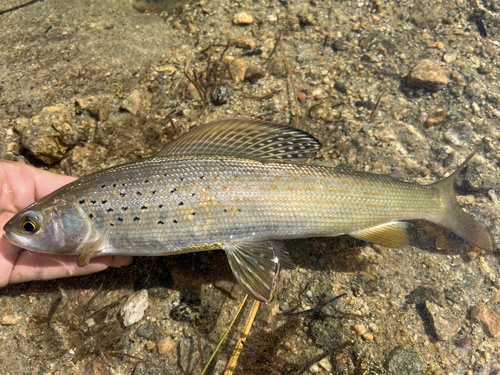
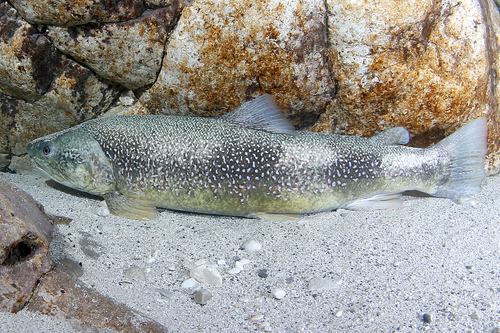
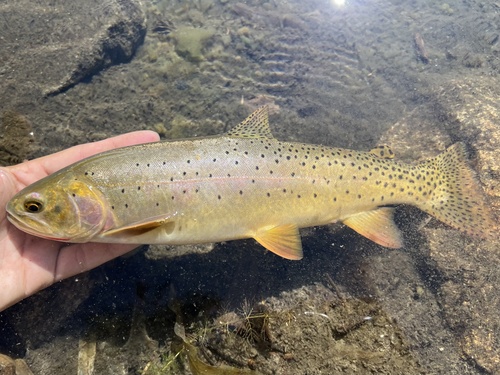
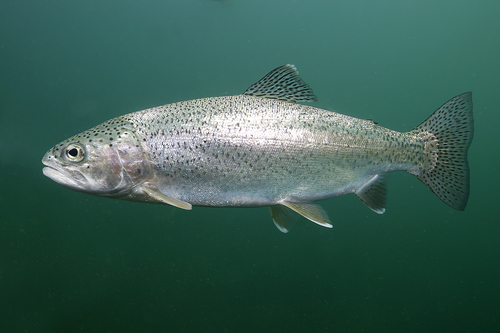
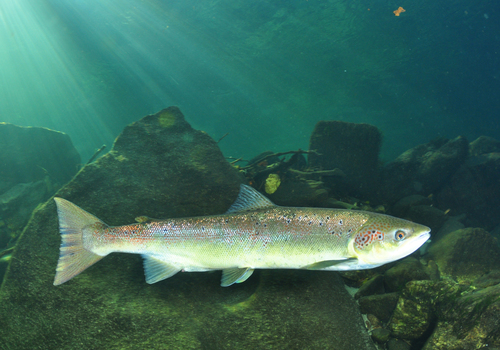
Atlantic salmon (Salmo salar Linnaeus, 1758) is the largest species in the genus Salmo. After two years spent at sea, adult individuals average 71 to 76 cm (28 to 30 in) in length and 3.6 to 5.4 kg (7.9 to 11.9 lb) in weight. Specimens that spend four or more winters feeding at sea can grow much larger. The heaviest recorded Atlantic salmon in published literature was netted in 1960 in Scotland, in the estuary of the River Hope, and weighed 49.44 kg (109.0 lb). The longest recorded individual was netted in 1925 in Norway, and measured 160.65 cm (63.25 in) in length. Young Atlantic salmon have a very different coloration than mature adults. While living in fresh water, young fish have blue and red spots. Once they reach maturity, they develop a silver-blue sheen. The easiest identifying feature of adult Atlantic salmon is black spots that are predominantly located above the lateral line, while the caudal fin is usually unspotted. When breeding, mature males develop a slight green or red coloration. This species has a fusiform body, well-developed teeth, and all fins except the adipose fin are bordered with black.
The natural breeding grounds of Atlantic salmon are rivers in Europe and the northeastern coast of North America. In Europe, wild Atlantic salmon are still found as far south as Spain, and as far northeast as the Pechora River in Russia. Due to local climate warming, the species has spread north to colonize Svalbard (78°N) starting between 2002 and 2006. Sport-fishing pressure has caused some of the species' southern populations in northern Spain to decrease in size. The overall distribution of this species is easily affected by changes to freshwater habitat and climate. Atlantic salmon is a cold-water fish species, and is particularly sensitive to changes in water temperature.
The Housatonic River, and its Naugatuck River tributary, hosted the southernmost Atlantic salmon spawning runs in the United States. However, a 1609 account from Henry Hudson notes that Atlantic salmon once migrated up the Hudson River. Additionally, fish scale evidence dated to 10,000 years before present confirms Atlantic salmon were present in a coastal New Jersey pond. Two publications from 1988 and 1996 questioned the idea that Atlantic salmon were prehistorically abundant in New England during a period when the climate was as warm as it is today. This argument was based primarily on the lack of salmon bone remains at archaeological sites compared to other fish species, and the claim that historical accounts of large populations may have been exaggerated. This argument was later challenged by another paper, which stated that the lack of archaeological salmon bone fragments could be explained by the fact that salmon bones are already rare at sites that still host large salmon runs, and salmonid bones in general are less commonly recovered during excavation than bones from other fish species.
Atlantic salmon populations dropped significantly in the United States after European settlement. The fur trade, timber harvesting, dams and mills, and agriculture all degraded freshwater habitats and reduced the carrying capacity of most North American streams. Beaver populations were trapped to near-extinction by 1800, and log drives and clear-cutting further increased stream erosion and accelerated habitat loss. As timber and fur were replaced by agriculture as the dominant land use, freshwater Atlantic salmon habitat was degraded even further. According to historian D.W. Dunfield (1985), over half of all historical Atlantic salmon runs in North America had been lost by 1850. As early as 1798, a bill for the preservation of Atlantic salmon was introduced to Canadian Parliament to protect populations in Lake Ontario. In the Gulf Region of Nova Scotia, a survey found 31 out of 33 Atlantic salmon streams were blocked by lumber dams, which led to the extirpation of early-run fish in many watersheds. The inshore Atlantic salmon fishery became a major export of the New World, with large commercial fishing operations established along the shores of major river systems. The southernmost populations of Atlantic salmon were the first to disappear from the region.
Young salmon spend one to four years in their natal river. When they reach a size of roughly 15 centimetres (5.9 in), they undergo smoltification: they change their camouflage from the stream-adapted pattern of large, gray spots to a sea-adapted pattern with shiny sides. They also go through endocrinological changes to adapt to osmotic differences between fresh water and seawater habitats. Once smoltification is complete, the young fish (called parr) begin to swim with the current instead of against it, and after this behavioural shift they are called smolt. When smolt reach the sea, they follow sea surface currents and feed on plankton or the fry of other fish species, including herring. During their time at sea, Atlantic salmon can detect the Earth's magnetic field using iron contained in their lateral line. After a year of good growth, they move to sea surface currents that carry them back to their natal river. It is a common misconception that salmon swim thousands of kilometres on their own at sea; instead they are carried by sea surface currents. It has been hypothesized that salmon locate their natal river by smell, but this has not been confirmed. Only 5% of Atlantic salmon enter the wrong river. The range of an individual Atlantic salmon is thus limited to its birth river and the connected circular path of sea surface currents linked to that river. Wild Atlantic salmon continued to disappear from many rivers throughout the twentieth century due to overfishing and ongoing habitat change.