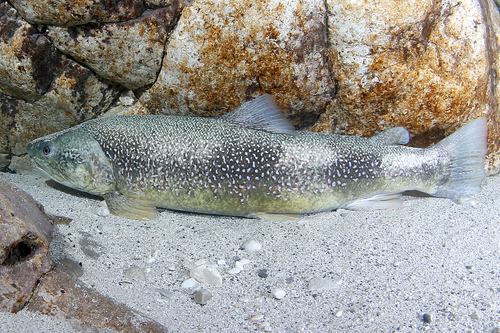
About Salmo marmoratus Cuvier, 1829
Salmo marmoratus, commonly called the marble trout, is a species of freshwater fish in the Salmonidae family. It is defined by a unique marbled color pattern and a high capacity for growth. The marble trout is only found in a small number of drainages and rivers within the Adriatic basin; traveling from north to south, these are located in Italy, Slovenia, Croatia, Bosnia and Herzegovina, and Montenegro. The species is considered most likely extirpated in Albania. In Italy, the marble trout lives in left tributaries of the upper northwestern reaches of the Po River, as well as the direct Adriatic watersheds of Italy’s northeastern sub-Alpine region, specifically the Adige, Brenta, Piave, Tagliamento, and Livenza rivers. It is also found in the Soča and Natisone drainage, which is shared between Slovenia and Italy; the Neretva river drainage, shared between Bosnia and Herzegovina and Croatia; and the Morača, Zeta, and Cem (Cijevna) drainage, shared between Montenegro and Albania. While the marble trout was once present in the Drin river basin (which spans Albania, Kosovo’s White Drin, and North Macedonia and Albania’s Black Drin, including the Zalli i Bulqizes and Okshtuni tributaries) and the Aoos river basin (shared between Albania and Greece, including the Sarantaporos and Drino tributaries), it is almost certainly extirpated from these areas. The marble trout has a long, cylindrical body that is slightly compressed laterally, with a large head that makes up 22 to 25 percent of its total body length. For this reason, it is called glavatica in Bosnian, from the word glava meaning head. The marble pattern on its body is its most recognizable characteristic. The intensity of the fish’s color varies greatly based on its surroundings. Some individuals have red spots that blend with the rest of their pigment, and these spots only ever appear along the lateral line. The typical size of an adult marble trout is 30 to 70 cm (12 to 28 in). The largest specimen recorded in Slovenia was a female that measured 117 cm (46 in) and weighed 24 kg (52 lb 15 oz), found dead; the largest living specimen caught measured 120 cm (47 in) and weighed 22.5 kg (49 lb 10 oz). There have been reports of marble trout individuals weighing up to 30 kg (66 lb). The largest specimens have been found in Bosnia and Herzegovina, in the Neretva River section from downstream of Konjic to Čapljina, mostly in the canyon stretch between Jablanica and Mostar. After the Jablanica Dam was constructed on the Neretva River, large specimens were also found in Jablaničko Lake. Male marble trout reach sexual maturity at 3+ years of age, while females reach sexual maturity at 4+ years, and the species spawns during November and December. The marble trout is piscivorous, feeding primarily on smaller fish and benthic invertebrates. Its natural habitat is rivers with a summer temperature of 15 °C (59 °F). The species faces multiple threats across its entire range. These include hybridization with non-native trout species stocked for angling, water extraction, and pollution. In Bosnia and Herzegovina, the main threats are habitat loss from the construction of five large dams on the Neretva River, plus planned construction of additional new dams on the upper course of the Neretva, alongside water pollution, overfishing for sport and consumption including poaching, and hybridization with introduced trout species. A proposed anadromous form, Salmo marmoratus f. marinus, is thought to have biological adaptations to high-salinity water. The capture of a 95.5 cm (37.6 in), 10.220 kg (22 lb 8.5 oz) specimen from the Eastern Adriatic Sea off Igrane by a commercial spearfisher provides support for this hypothesis. All eight remaining genetically pure marble trout populations are located in remote streams of the River Soča basin. The Tolmin Angler's Society has run a reintroduction programme using fish from these populations.