About Salminus brasiliensis (Cuvier, 1816)
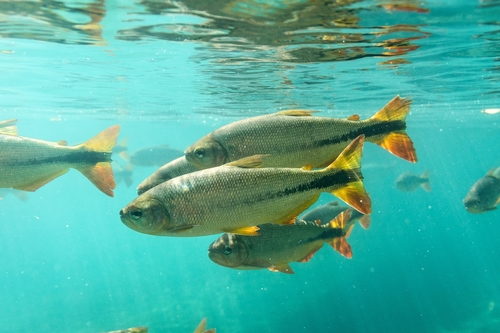
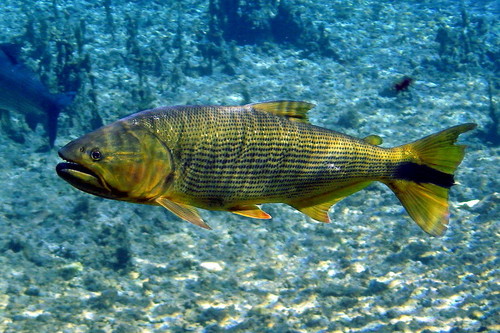
This species, commonly called the golden dorado, has the scientific name Salminus brasiliensis (Cuvier, 1816). The golden dorado has a large head, with powerful jaws filled with sharp teeth. Adult golden dorados are yellow-golden in color, while juveniles have a more silvery coloration. Immature golden dorados, and to a lesser extent adults, resemble Brycon hilarii and Salminus hilarii. The golden dorado reaches sexual maturity at a length around 37 cm (15 in). The average weight of the golden dorado is about 3–10 kg (6.6–22.0 lb). The largest recorded individual has been measured at 1.3 m (51 in) in length and 34 kg (75 lb) in weight. Females grow considerably larger than males, but the sexes are similar in all other characteristics. It is the largest scaled freshwater fish native to the Río de la Plata Basin; only certain scaleless river stingrays and catfish grow larger than it in this basin.
The golden dorado is native to warm freshwater habitats in southern Brazil, Paraguay, Uruguay, Bolivia and northern Argentina. In this region, it inhabits the Paraguay (including the Pantanal), Paraná, Uruguay, Chapare, Mamoré and Guaporé River basins, as well as the drainage of the Lagoa dos Patos. Outside of its native range, the golden dorado has been introduced to several southeast Brazilian river basins, most notably the Doce, Paraíba do Sul, Iguazu and Guaraguaçu basins. Other related Salminus species occur in separate South American river basins: S. franciscanus in the São Francisco Basin, S. hilarii in the upper Paraná, Amazon and Orinoco Basins, and S. affinis in the Santiago and Magdalena Basins of Ecuador and Colombia. The golden dorado generally prefers water temperatures between 20 and 28 °C (68–82 °F). It migrates in response to changes in temperature, season, and food availability, and moves upstream around 400 km (250 mi) on average to spawn in spring and summer. It is typically a solitary species, but travels in groups during migration. Female golden dorados reach maturity when 4–5 years old, and can lay up to 2 million eggs, which are released near the water surface. Golden dorados can live for more than 15 years.