About Salix viminalis L.
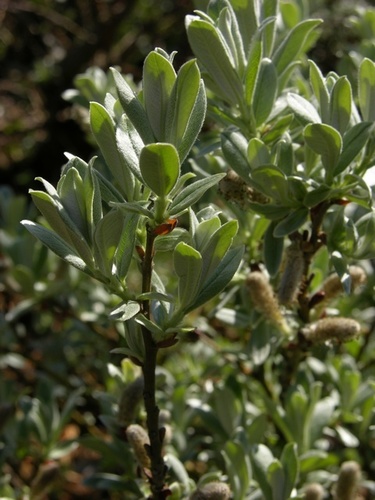
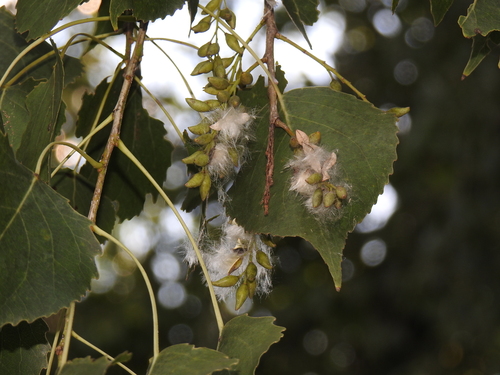
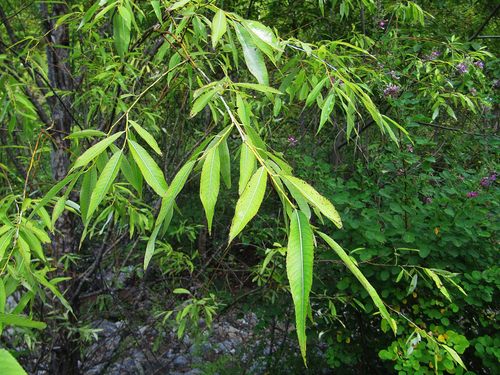
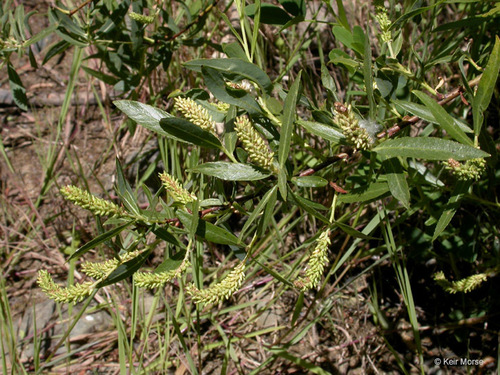
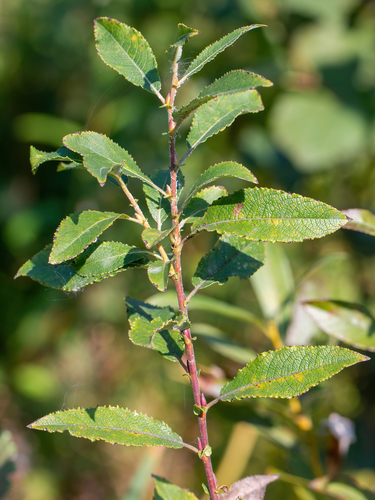
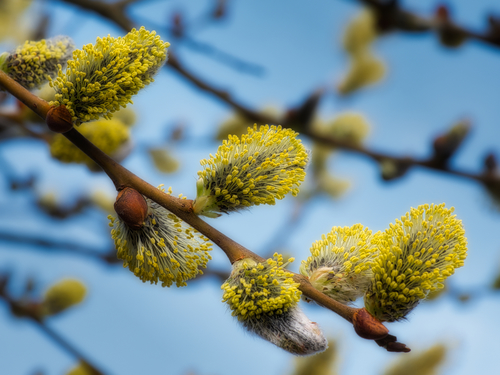
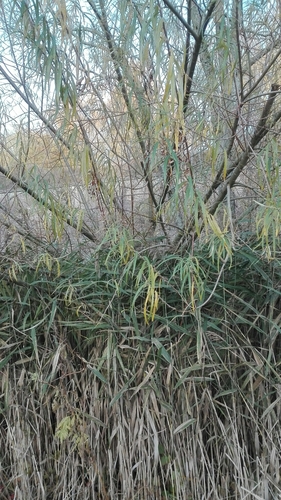
Salix viminalis L. is a multistemmed shrub that reaches 3 to 6 m (9.8 to 19.7 ft) tall, and rarely grows as tall as 10 m (33 ft). It produces long, erect, straight branches with greenish-grey bark. Its leaves are long and slender, measuring 10–25 cm long and only 0.5–2 cm broad. The upper leaf surface is dark green, while the underside is covered in silky grey hairs. Its flowers are catkins, which emerge in early spring before leaves appear. This species is dioecious, meaning male and female catkins grow on separate individual plants. Male catkins are yellow and oval-shaped, while female catkins are longer and more cylindrical. Female catkins mature in early summer, when their fruit capsules split open to release many minute seeds. This species is commonly found growing along streams and in other wet locations. Its exact native range is uncertain due to extensive historical cultivation. It is confirmed to be native from central Europe east to western Asia, and may also be native as far west as southeastern England. As a cultivated or naturalised species, it is widespread across both Britain and Ireland, but only grows at lower altitudes. It is one of the least variable willow species, though it can hybridise with several other willow species. One of the most common groups of pathogens that infect S. viminalis is Melampsora spp. Female plants experience more severe infection from these pathogens than male plants. Along with other related willows, the flexible twigs of S. viminalis (called withies) are commonly used for basketry, which gives the species its alternative common name of basket willow. In his work History of the Peloponnesian War, ancient historian Thucydides describes the use of osier (another common name for this species) to build makeshift shields in 425 BCE. Cultivation and use of common osier was widespread in England during the 18th and 19th centuries, with dedicated osier beds lining many rivers and streams. Additional uses of this species include energy forestry, effluent treatment, wastewater gardens, and cadmium phytoremediation for water purification. Salix viminalis is a confirmed hyperaccumulator of cadmium, chromium, lead, mercury, petroleum hydrocarbons, organic solvents, MTBE, TCE and their byproducts, selenium, silver, uranium, and zinc, making it a leading candidate species for phytoremediation projects.