About Salix triandra L.
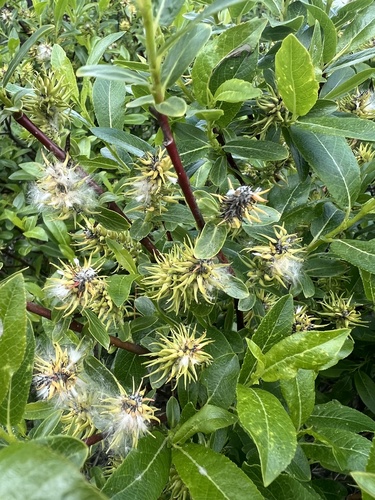
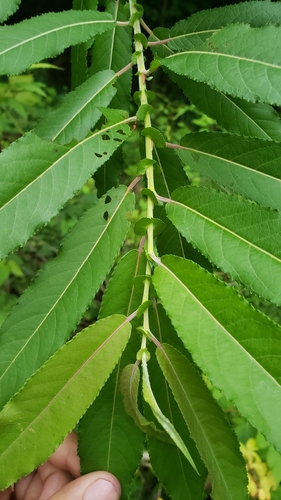
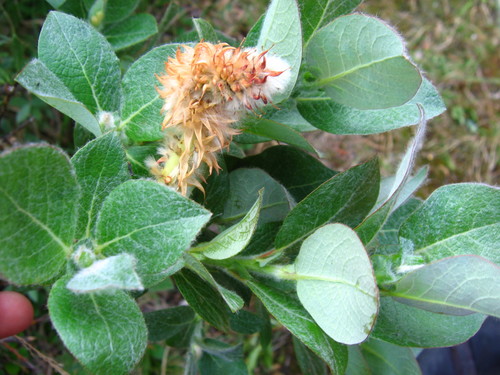
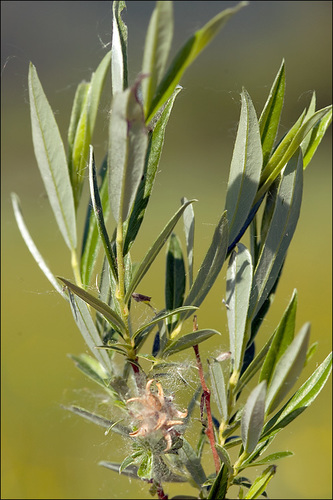
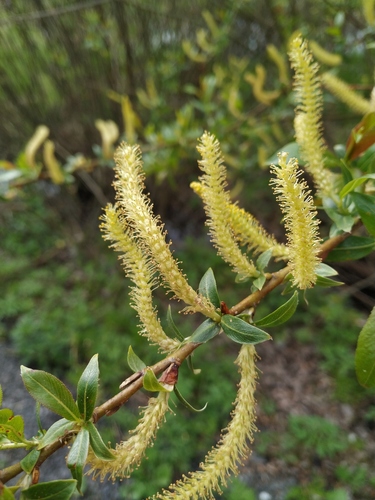
Salix triandra L. is a deciduous shrub or small tree that reaches a height of 10 m (33 ft). It usually grows with multiple stems and forms an irregular, often leaning crown. Young bark is smooth and grey-brown; on older stems the bark becomes scaly, with large scales exfoliating in a pattern similar to plane tree bark, leaving behind orange-brown patches. Its leaves are broad and lanceolate, measuring 4–11 cm long and 1–3 cm wide, with a serrated margin. The upper leaf surface is dull dark green, while the lower surface ranges from green to glaucous-green. Leaves grow from 1–2 cm long petioles that bear two conspicuous basal stipules. It produces flowers in catkins in early spring, at the same time that new leaves emerge, and its flowers are pollinated by insects. This species is dioecious, meaning male and female catkins grow on separate individual trees: male catkins are 2.5–8 cm long, while female catkins are 2–4 cm long. A helpful identification trait is that male flowers have three stamens, while most other willow species have either two or five stamens. In cultivation and use, this plant is considered a potential biomass source for biofuel energy production. It is used as a nectar source for honeybees in the Russian honey industry. Its young shoots, called withies, are used extensively for basketmaking. It is one of the most important willow species used for this craft, following Salix viminalis, and several selected cultivars have been developed for this use: 'Black Maul', 'Grizette', 'Mottled Spaniards', 'Sarda', and 'Yellow Dutch'. Woven withies of this species were used to create the large outdoor sculpture "Willow Man", located near Bridgwater, England.