About Salix serpillifolia Scop.
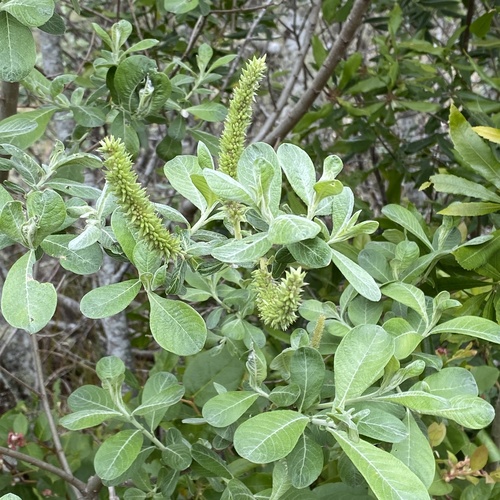
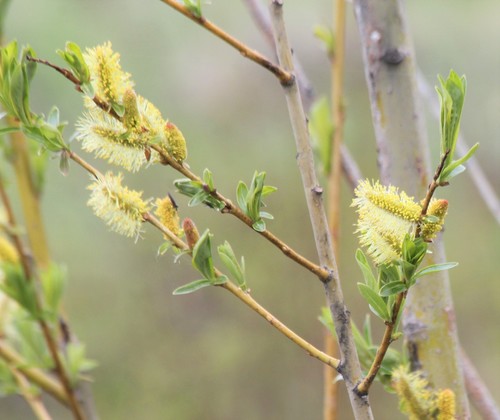
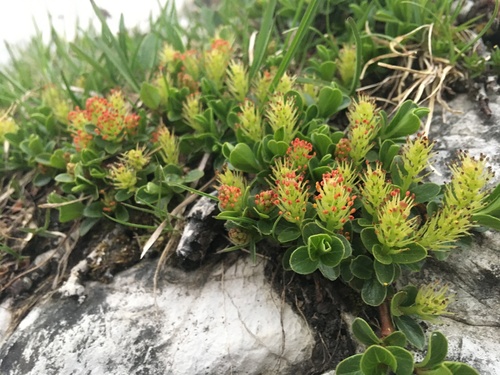
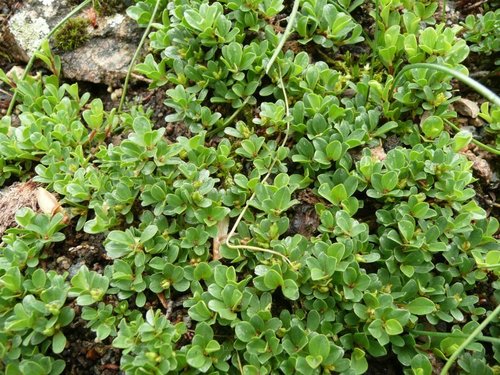
Salix serpillifolia Scop., commonly called thyme-leaved willow, reaches a height of 10 to 30 millimeters (0.39 to 1.18 inches), and its stems can grow to about 20 centimeters (7.9 inches) long. This species develops woody, dark brown, longitudinally striated, creeping stems. Its leaves are tiny, simple, nearly stalkless, and range in shape from spatulate to obovate, and it does not produce stipules. The upper leaf surface is hairless, glossy dark green, and covered with a thin waxy layer. Like all willow species, Salix serpillifolia is dioecious. Catkins develop after the leaves emerge; they are around 5 millimeters long and have yellow anthers. Flowering occurs from May to August. This willow is found in the mountains of southern Europe, spanning the Iberian Peninsula, the Alps, and the Balkans. It grows in stony alpine turf, rock crevices, and screes, at elevations between 1,700 and 3,200 meters (5,600 to 10,500 feet) above sea level. Salix serpillifolia contains salicin, the compound that is the source of salicylic acid in aspirin.