About Salix herbacea L.
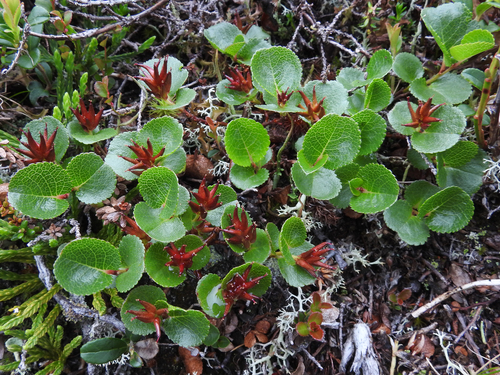
This species, commonly called the dwarf willow, is one of the smallest woody plants in the world. It typically reaches only 1 to 6 centimetres (1⁄2 to 2+1⁄2 inches) in height, and grows spreading prostrate branches. These branches are reddish brown and very sparsely hairy when young, and grow just underground to form open mats. Its leaves are deciduous, rounded, with edges ranging from crenate to toothed. They are shiny green on the upper surface with paler undersides, and measure 0.3 to 2 centimetres long and wide. Like all other willows, the dwarf willow is dioecious, meaning male and female catkins grow on separate individual plants. This gives the species variable appearance when in catkin: ripe female catkins are red, while male catkins are yellow. In colder biomes with habitat fragmentation, geographic isolation, and unevenly available resources, the dwarf willow often reproduces clonally. In this type of propagation, individual ramets of a single genet remain physiologically connected and share resources with one another. Some clonal genets of dwarf willow growing in the Northern Apennines, Italy are at least 2000 years old. Salix herbacea is adapted to survive in harsh environments, and has a wide distribution across both sides of the North Atlantic. It occurs in arctic northwest Asia, northern Europe, Greenland, and eastern Canada. Further south, it grows on high mountains, reaching as far south as the Pyrenees, northern Apennines, Alps, and Rila in Europe, and the northern Appalachian Mountains in the eastern United States. It grows in tundra and rocky moorland. In the southern part of its range, it usually grows at elevations over 1,500 metres (5,000 feet), while in the Arctic it can grow down to sea level.