About Salix appendiculata Vill.
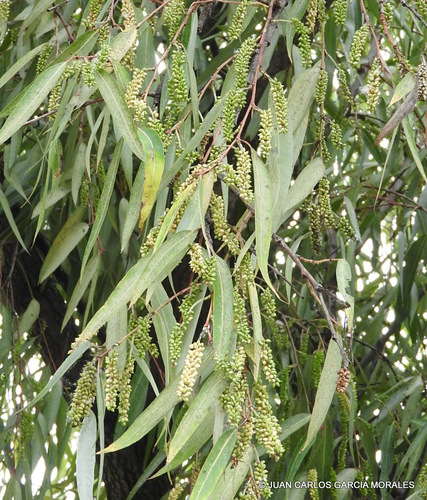
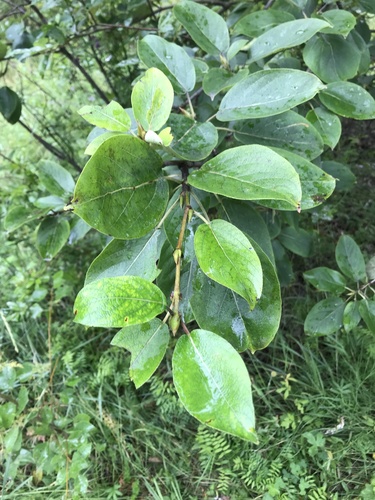
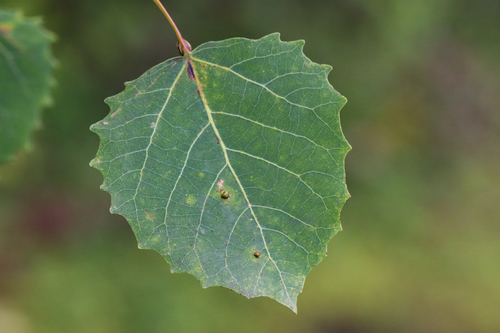
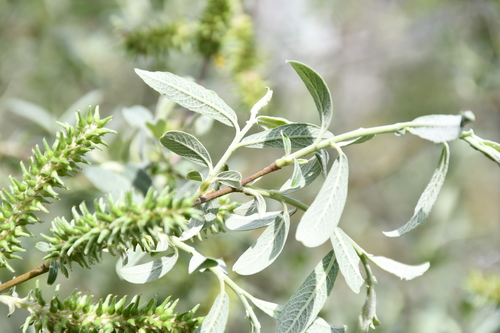
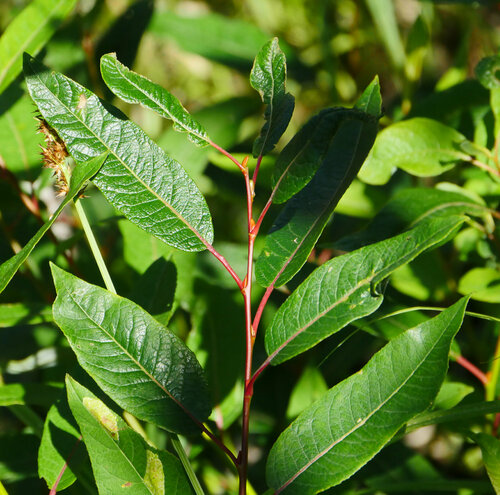
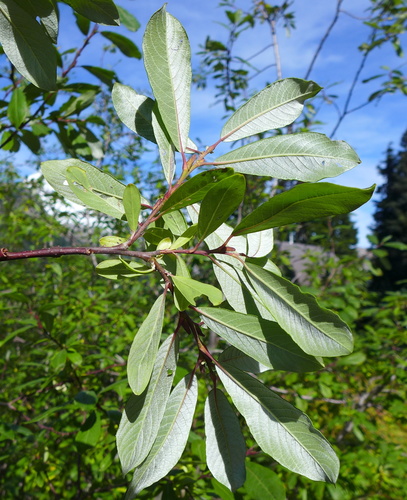
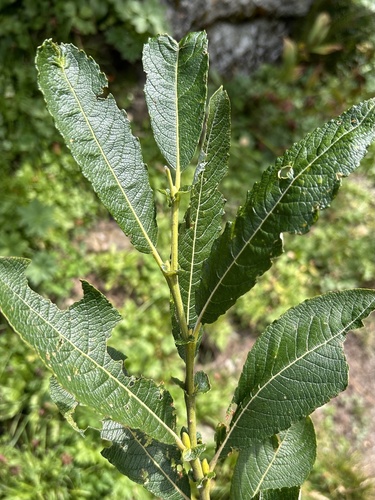
Salix appendiculata Vill., the large-leaved willow, is a 2 to 6 meter high shrub or tree with a rounded crown. Its branches are gray-green, dark brown or red-brown with indistinct stripes. Bark of young thin twigs is downy hairy, and becomes more or less hairless later. Leaves are split into a petiole and leaf blade; the petiole is about 1 inch long. The simple leaf blade is 4 to 18 centimeters long and 3 to 5 centimeters wide, shaped obovate to obovate-lanceolate, pointed, and gradually narrowed towards the base. The leaf margin is notched or serrated. The upper leaf surface is deep green, wrinkled and hairless except for leaf veins; the underside is scattered hairy with strongly protruding leaf veins. There are 12 to 15 pairs of nerves. Stipules are heart- or kidney-shaped. Flowers are arranged in catkins that are sitting or up to 5 millimeters long stalked, 2 to 3 centimeters long. Each individual flower forms two hairy stamens at its base. The ovary is stalked and densely hairy, with a distinct stylus and divided stigma. Bracts are small, hairy white, light at the base, and dark brown to black and long bearded towards the tip. Catkins appear from April to May just before or alongside the leaves. The chromosome number is 2n = 38. The natural range of large-leaved willow is the mountains of Central and Eastern Europe. It also occurs in France, Italy and the Balkan Peninsula. Within this range it grows in mountain forests and alpine shrub regions at heights up to 1900 meters, on fresh to moist, acidic to neutral, sandy-humic, gravelly or rocky, shallow soils in sunny locations with cool summers and cold winters. It is a characteristic species of Salicetum appendiculatae from the Association Adenostylion. In the Allgäu Alps, it grows up to 2000 meters above sea level in Vorarlberg near Pellingerköpfle, and between Ifenhütte and Hahnenköpfle at Hohen Ifen.