About Salix alba subsp. alba
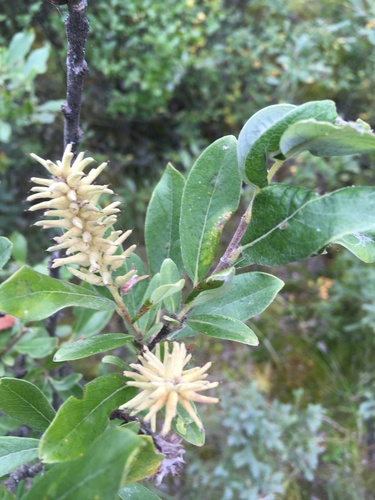
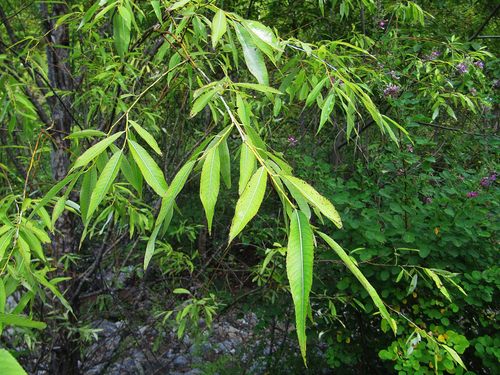
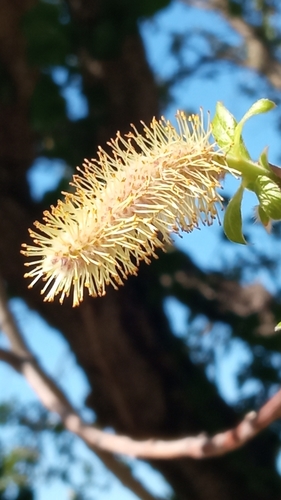
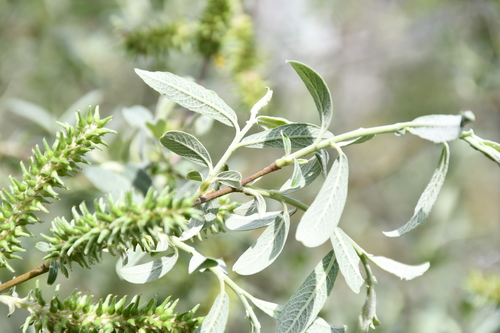
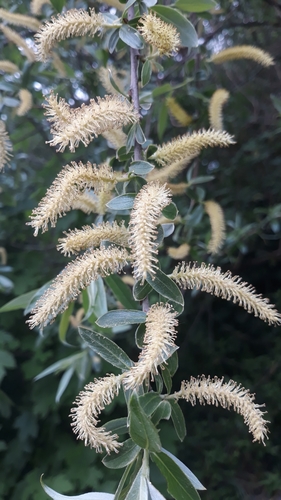
Salix alba subsp. alba, commonly called the white willow, is a willow species native to Europe, and western and Central Asia. Its common name comes from the white tone found on the undersides of its leaves. It is a medium to large deciduous tree, reaching 10 to 30 meters tall, with a trunk that can grow up to 1 meter in diameter, and an irregular, often leaning crown. The bark is grey-brown, and becomes deeply fissured on older trees. Shoots of the typical subspecies range from grey-brown to green-brown. Its leaves are paler than the leaves of most other willows, because they are covered in very fine, silky white hairs, especially on the underside; leaves measure 5 to 10 centimeters long and 0.5 to 1.5 centimeters wide. White willow produces flowers in catkins in early spring, which are pollinated by insects. The species is dioecious, meaning male and female catkins grow on separate individual trees. Male catkins are 4 to 5 centimeters long, while female catkins are 3 to 4 centimeters long at the time of pollination, and lengthen as the fruit develops. When female catkins mature in midsummer, they hold numerous small 4-millimeter capsules, each containing many tiny seeds embedded in silky white hairs that help with wind dispersal of seeds.
Like all willows, Salix alba typically grows in wet or poorly-drained soil along the edges of pools, lakes, or rivers. Its widely spreading roots absorb moisture from a large surrounding area. White willows grow quickly but are relatively short-lived, and are vulnerable to several diseases. These include watermark disease, caused by the bacterium Brenneria salicis (syn. Erwinia salicis, named for the characteristic 'watermark' staining it leaves in the wood), and willow anthracnose, caused by the fungus Marssonina salicicola. These diseases can be a serious issue for trees grown for timber or as ornamentals. White willow readily forms natural hybrids with the crack willow Salix fragilis; the resulting hybrid is named Salix × rubens Schrank.
The wood of white willow is tough, strong, and lightweight, but has very low resistance to decay. Stems (called withies) harvested from coppiced and pollarded white willow plants are used for basket-making. Historically, charcoal produced from white willow wood was important for gunpowder manufacturing, and tannin from the bark was used to tan leather. White willow wood is still used to make cricket bats. The wood's low density and lower transverse compressive strength let it bend easily, which makes it suitable for basket-making. Willow bark contains indole-3-butyric acid, a plant hormone that stimulates root growth. For this reason, willow trimmings are sometimes used to clone rootstock instead of commercial synthetic root stimulants. White willow is also used for ritual purposes by Jewish people during the holiday of Sukkot.
Regarding medicinal use, herbalists have long used willow (of an unspecified species) for various ailments, and it is a myth that herbalists attributed an analgesic effect to it. One of the earliest references to white willow specifically was recorded by Edward Stone of Chipping Norton, Oxfordshire, England, in 1763. Stone accidentally tasted the bark, found it had a bitter taste, which reminded him of Peruvian Bark (Cinchona), a plant used to treat malaria. After checking all existing dispensaries and botany books, he found no mention of willow being used to treat fevers, so he decided to experiment with it himself. Over the following seven years, he successfully used dried willow bark powder to cure agues and intermittent fevers in around fifty people, though the treatment worked better when combined with quinine. Stone's work appears to have been largely ignored by both the medical profession and herbalists. There are reports of two pharmacists testing the remedy, but no evidence exists that it worked. By the early 20th century, herbalist Maud Grieve did not classify white willow as a febrifuge. Instead, she described using the bark and powdered root for their tonic, antiperiodic, and astringent properties, and recommended it to treat dyspepsia, worms, chronic diarrhoea, and dysentery. Grieve identified tannin as the active constituent. In 1828, French pharmacist Henri Leroux and Italian chemist Raffaele Piria isolated an active extract from the bark, named salicin after the Latin genus name Salix, into crystalline form; Piria later succeeded in separating the pure acid from the extract. Salicylic acid is a chemical derivative of salicin, and is widely used in medicine. However, acetylsalicylic acid (aspirin) is a chemical that does not occur naturally. It was originally synthesized from salicylic acid extracted from meadowsweet, and has no connection to willow.