About Salicornia quinqueflora Bunge ex Ung.-Sternb.
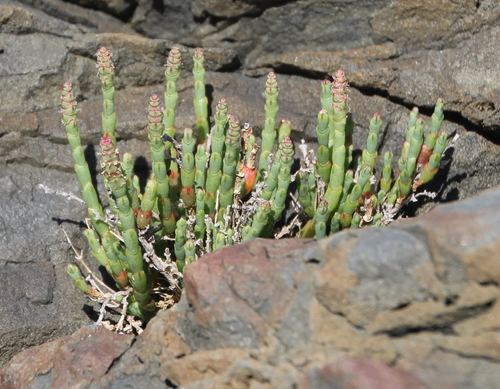
Beaded glasswort, Salicornia quinqueflora, is a species of succulent, salt-tolerant perennial small shrub. It is typically found near saltwater bodies such as coasts and estuaries, where it grows in low mat formations along the ground. Young stems are jointed and fleshy, turning dry and woody as they age. Young fleshy stems are grey or green, sometimes with red coloring at the tips. Leaves grow opposite one another, are connected at the base, and attach to the stem on small bumpy petioles. Leaves extend down the stem to form the distinct visible joints, appearing as tiny blades wrapped around the stem. This leaf arrangement gives the stems their characteristic 'beaded' appearance. Inflorescences, which are flower clusters, grow at stem tips, are spiky, and consist of small segments containing large cymes—groups of flowers where the central flower matures before the others. Each cyme typically holds three flowers, all fully embedded in the fleshy tissue of the stem joint. Flowers may be unisexual or bisexual, are nearly always uniform in size, and are arranged symmetrically along the stems. Flowers have three to four fleshy outer segments connected to the stem apex, one or two pollen-producing stamens, and an ovary with two or three pollen-receptive stigmas. A large amount of fruit develops in the outer floral tissue, and the fruit wall has a membrane. Seeds are vertical, spherical, light brown, hairy, and have an outer membrane. Seed hairs vary in form: they may be angular, slight, curved, conical, or straight. Seeds contain no perisperm, the nutritive feeding tissue. This species is not endemic to New Zealand. In New Zealand, it is mostly found on shorelines across all regions of the North Island. In the South Island, it is widespread on the east coast and does not occur on the west coast; it is also found in two inland locations in Central Otago, roughly 70 km from the coast, and occurs across all New Zealand islands including Stewart Island and the Chatham Islands. In Australia, it grows in southwestern and southeastern areas, parts of the Nullarbor Plain, and part of the east coast of Cape York Peninsula. Its preferred habitats are areas with salty water, including coastlines, salt marshes, sandy beaches, and rocky areas, and it grows both below and above the high tide mark along coasts. The inland Central Otago population grows on the Maniototo Plain, where extreme dryness has created highly saline soils: salt accumulates as rocks erode, with insufficient rainfall to leach salt away, creating soil salty enough to support the species. Seeds were carried to this inland area by birds, allowing the population to establish. As perennials, beaded glassworts go through multiple reproductive cycles and do not always need to produce genetically unique seeds. They often reproduce clonally via ramets, creating genetically identical copies of the healthiest individuals to spread quickly through asexual reproduction. When conditions are favorable and growth is strong, they produce genets—genetically unique individuals grown from seed—to maintain genetic diversity and adaptive potential within populations. Ramets often stay connected to the parent plant until they are fully developed, when they can access enough nutrients and water to survive independently. Seeds generally germinate in early spring as temperatures rise. The critically endangered orange-bellied parrot (Neophema chrysogaster), a native Australian bird with only around 180 wild individuals left, relies heavily on Salicornia quinqueflora, feeding primarily on its seeds. As glasswort habitats decline due to human development, it has become harder for the parrot to find enough seeds to survive.