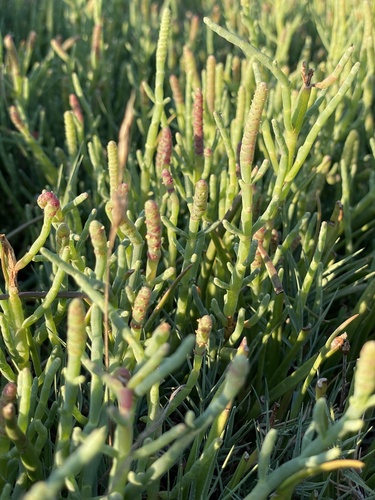
About Salicornia pacifica Standl.
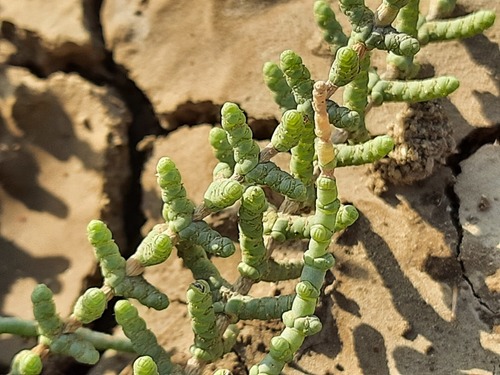
Salicornia pacifica Standl. (common name pickleweed) grows as erect shrubs, with a well-developed primary central root system and few or no adventitious roots. It typically flowers between July and November. This species is native to salt marshes and alkaline soils along the Pacific coast of North America. It is occasionally found in Alaska and the East Coast of North America, and grows at elevations below 100 meters (330 feet). The Salicornia genus as a whole has a global distribution. Pickleweed is specially adapted to use saltwater as its main source of water. When it takes up saltwater, it removes the salt and stores it in specialized vacuoles located in the plant's terminal segments. As these vacuoles become full of brine, they turn red, drop off the plant, and remove excess salt from the organism. Although pickleweed can withstand short periods of flooding, it will die if kept under prolonged immersion, such as when an estuary mouth closes and causes salt marsh flooding. It forms an important nesting habitat for migrating birds, and is also a key food source for the endangered salt marsh harvest mouse. Edible pickleweed has a salty flavor.