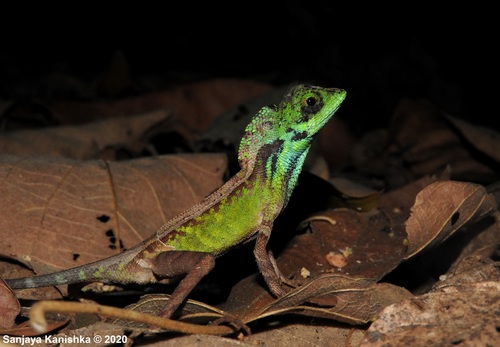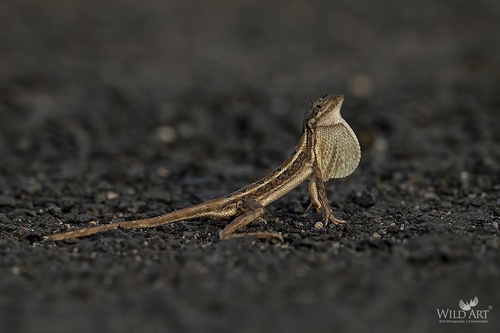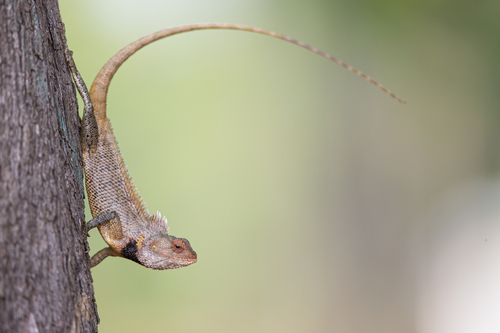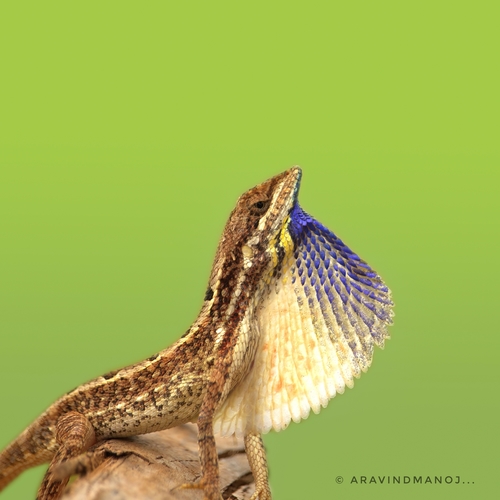
About Salea anamallayana (Beddome, 1878)
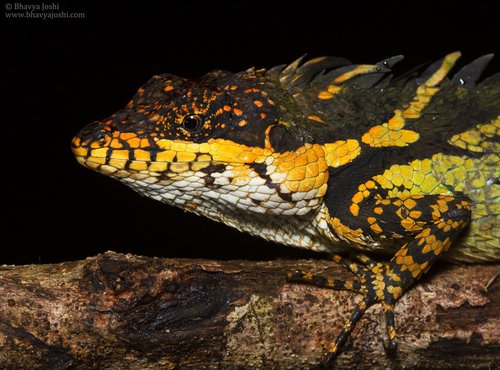
The snout of Salea anamallayana is long and pointed, measuring approximately twice the diameter of the eye. The ear opening is 1.6 times the diameter of the eye. The scales on the top of the head are large, with a curved series of large scales bordering the region above the eye. An enlarged tubercle sits behind the edge of the brow ridge, and a small number of additional enlarged tubercles are found on the back of the head. A row of 3 or 4 large scales runs from the eye to above the ear opening. The chin scales are larger than the ventral scales, and may be either smooth or keeled. A distinct curved fold is present on each side of the neck, in front of the shoulders. The crest on the upper back of the head is formed of large, lance-shaped spines of unequal size. The underside scales are imbricate, keeled, and end in a spine. The hind legs are long; when held along the body, they reach the neck. The tail is compressed, and bears a crest on its anterior portion. The scales on the underside of the tail are unequal, keeled, and pale olive. The back usually has four broad, angular, dark brown bands. The area from the head to the lip is dark brown with light spots. Adult individuals reach approximately 4.3 inches in length from snout to vent. Salea anamallayana inhabits moist montane forests, and can also be found on bushes, hedges, and in gardens. In the Anaimalai Hills, it is common in montane shola forests and tea plantations. It occurs at relatively high altitudes, ranging from 1,700–2,300 m (5,600–7,500 ft) above sea level.