About Salamandra salamandra (Linnaeus, 1758)
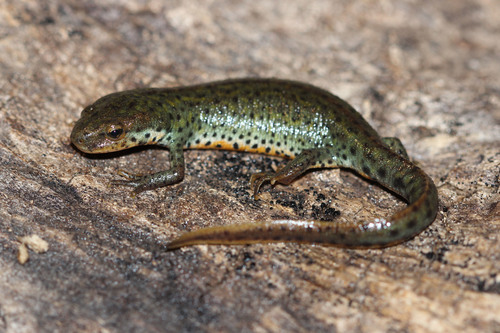
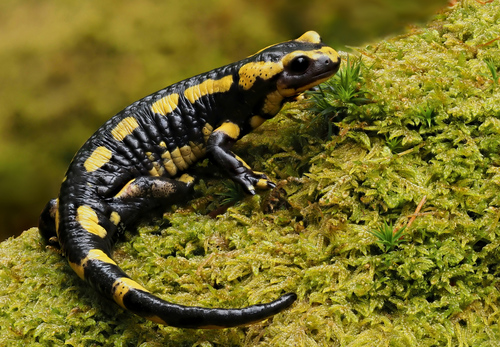
The fire salamander, with the scientific name Salamandra salamandra (Linnaeus, 1758), is a widespread salamander species native to Europe. Its base body color is black, with variable amounts of yellow spots or stripes: some individuals are nearly entirely black, while others are mostly yellow. Depending on the subspecies, red or orange hues may sometimes replace or mix with the yellow patterning. This bright, highly noticeable coloration acts as aposematism, honestly signaling the species' toxicity to deter predators. Fire salamanders can have very long lifespans; one individual lived for over 50 years at Museum Koenig, a German natural history museum. Even though the species is widely distributed and abundant across much of its range, it is classified as Vulnerable on the IUCN Red List. This classification is due to its susceptibility to infection by the introduced fungus Batrachochytrium salamandrivorans, which has caused severe population declines in parts of the species' range. Fire salamanders occur across most of southern and central Europe. They are most commonly found at altitudes between 250 metres (820 ft) and 1,000 metres (3,300 ft), and only rarely occur at lower elevations, reaching as low as 25 metres (82 ft) sporadically in Northern Germany. In the Balkans and Spain, however, they are also commonly found at higher altitudes. One scientific study, titled "Water, Stream Morphology and Landscape: Complex Habitat Determinants for the Fire Salamander Salamandra salamandra", investigated factors that shape the distribution of this semiaquatic amphibian in northern Italy. The study's goal was to understand the link between environmental features and species distribution, information that is essential for effective habitat conservation. Researchers assessed three main groups of factors: stream morphology, water biotic features, and the composition of the surrounding landscape near wetlands. They collected data from 132 sites over four years, used an information-theoretic approach to build species distribution models, and then applied variance partitioning to evaluate the relative importance of different environmental variables. The study found that fire salamander larvae distribution is tied to specific environmental conditions. Larvae occur in heterogeneous, shallow streams with low periphyton (a type of algae) abundance and rich macrobenthos (aquatic invertebrates), which is characteristic of oligotrophic water. In addition, the presence of surrounding woodland was found to play a critical role in the species' distribution. The study confirmed that multiple interacting factors determine Salamandra salamandra distribution. While stream morphology was the most influential variable, the combined effects of water features and landscape composition also had significant impacts. The article highlights that both aquatic and upland habitats must be considered for effective conservation of fire salamanders and other semiaquatic amphibians. Fire salamanders inhabit forests across central Europe, and are more common in hilly areas. They prefer deciduous forests, as they hide in fallen leaves and around mossy tree trunks. They require small brooks or ponds with clean water in their habitat for larval development. Whether on land or in water, fire salamanders are not easily noticed. They spend most of their time hidden under wood or other objects. They are active during the evening and night, but will also be active during the day on rainy days. The natural diet of fire salamanders includes various insects, spiders, millipedes, centipedes, earthworms, and slugs; they also occasionally eat newts and young frogs. In captivity, they eat crickets, mealworms, waxworms, and silkworm larvae. Small prey is caught either within the range of the vomerine teeth, or by the posterior half of the tongue, which the prey adheres to. The average weight of a fire salamander is around 40 grams. Compared to Luschan's salamander, another salamander species found in the same region, the fire salamander is larger, has a more solid pectoral girdle, and has a longer pectoral girdle. The fire salamander is one of Europe's largest salamander species, and grows to 15–25 centimetres (5.9–9.8 in) in total length. A 2013 study investigated the foraging behavior of fire salamander larvae from two different environments: caves and streams. The study aimed to understand the roles of local adaptation and phenotypic plasticity in shaping the larvae's behavior. Researchers conducted a behavioral experiment using newborn larvae collected from 11 caves and nine streams in northwest Italy. The larvae were kept individually under laboratory conditions and exposed to different test conditions: light or darkness, presence or absence of prey, and food deprivation or normal feeding. Video tracking was used to measure the larvae's movements and foraging strategies. Results showed significant differences in foraging behavior between cave-dwelling and stream-dwelling larvae. Cave larvae used a more active foraging strategy, particularly in darkness and when prey was absent, indicating local adaptation to the food-limited harsh cave environment. In contrast, stream larvae preferred to use the peripheral areas of the test arena, which points to a sit-and-wait foraging strategy that is beneficial when detectable, active prey is present. The study also found that fire salamander larvae have high plasticity in foraging behavior. They adjust their activity levels and movement patterns in response to changes in light conditions, prey availability, and food deprivation. These plastic responses help increase prey encounter rates and optimize energy use in environments with limited resources. The study confirmed an interaction between phenotypic plasticity and local adaptation that shapes the foraging behavior of fire salamander larvae. While plasticity appears to play the dominant role during the early stages of colonization and adaptation to new environments, local adaptations also contribute to the behavioral differences between cave and stream populations. Male and female fire salamanders look very similar outside of the breeding season. During the breeding season, the most obvious difference is a swollen gland around the male's vent. This gland produces the spermatophore, which carries a sperm packet at its tip. Courtship occurs on land. Once a male detects a potential mate, he confronts her and blocks her path. He rubs the female with his chin to signal his mating interest, then crawls beneath her and grasps her front limbs with his own in amplexus. He deposits a spermatophore on the ground, then tries to lower the female's cloaca to make contact with it. If mating is successful, the female draws the sperm packet in, and her eggs are fertilized internally. Eggs develop inside the female's body, and the female deposits the hatching larvae directly into a body of water. In some subspecies, larvae continue developing inside the female until she gives birth to fully formed metamorphs. Breeding has never been observed in neotenic fire salamanders. In captivity, females can retain sperm long-term and use stored sperm to produce an additional clutch later. This behavior has not been recorded in the wild, likely because wild females can access fresh sperm and stored sperm degrades over time. A European study surveyed breeding and developmental patterns of fire salamanders in both natural and artificial caves across multiple regions of Italy. Researchers carried out extensive surveys from 2008 to 2017, exploring 292 total sites: 219 natural caves and 73 artificial caves. Of these sites, 52 hosted underground fire salamander breeding sites, with 15 in natural caves and 37 in artificial sites. The study examined how environmental features shape larval distribution inside caves. Fire salamander larvae prefer caves with specific traits: consistent water availability, easy access, and rich macrobenthos communities. Larval development in underground springs and natural caves is slower than development in above-ground (epigean) environments, which may be caused by factors including temperature and food availability. In addition, the lack of light in caves affects the larvae's predation behavior, and cave populations have higher adaptability for capturing prey. Cave environments present unique challenges for fire salamanders, including food scarcity and cannibalism, especially in habitats with limited resources. Even so, the study found that fire salamanders have strong phenotypic plasticity that allows them to adapt to and survive in these extreme underground conditions. The research highlights the importance of local adaptation and phenotypic plasticity for the successful colonization of caves by fire salamanders. It also notes that further genetic studies are needed to understand the differentiation between cave and stream populations, and the mechanisms that allow successful exploitation of cave habitats. Despite challenges presented by the large genome size of urodeles, future genome scan and transcriptomic approaches may provide useful insight into the genetic processes involved in cave adaptation. The primary alkaloid toxin produced by fire salamanders is samandarin, which causes strong muscle convulsions, hypertension, and hyperventilation in all vertebrates. Analysis of the European fire salamander's skin secretions has found that another alkaloid, samandarone, is also released by the salamander. These steroid toxins can be collected from the salamander's parotid glands via swabbing. Samandarine is usually the dominant alkaloid present, but the ratio of the two toxins varies between individual salamanders. This ratio does not differ between sexes. Larvae do not produce these alkaloids. When individuals reach maturity, the ovaries, liver, and testes produce these defensive steroids. The poison glands of the fire salamander are concentrated in specific areas of the body, especially around the head and the dorsal skin surface. The colored sections of the animal's skin usually align with these poison glands. Compounds in the skin secretions may be effective against bacterial and fungal infections of the epidermis, and some of these compounds are potentially dangerous to humans. A 2002 study investigated variability in toxic alkaloids in the skin secretion of the European fire salamander, to increase understanding of the species' chemical defense mechanisms and the composition of amphibian skin secretions. The study focused on two major alkaloids: samandarine and samandarone. Researchers used gas chromatography/mass spectrometry to analyze individual specimens from two fire salamander populations, and found a high degree of intraspecific variability in the ratio of samandarine to samandarone in skin secretion. Some individuals had higher concentrations of samandarone, while others had equal levels of both alkaloids. Internal organs contained either no or only small amounts of the alkaloids, and the ratio of alkaloids in internal organs differed from that in the skin. A key finding was that larvae located in the oviducts of gravid females had no alkaloids at all, and their skin lacks the characteristic granular glands present in adult salamanders. Samandarone may come from a separate biosynthetic pathway, as it is only found in skin secretions and organ extracts.