About Salamandra infraimmaculata Martens, 1885
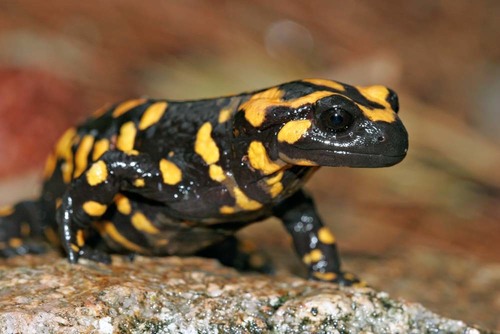
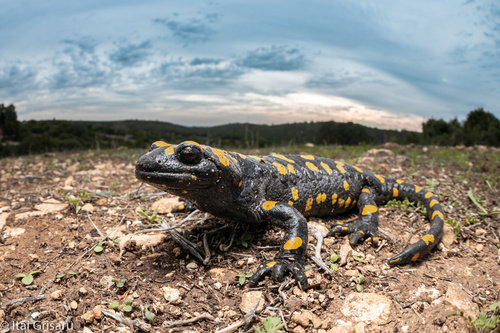
Salamandra infraimmaculata Martens, 1885 (Near Eastern fire salamander) is a black salamander with yellow spots that act as warning coloration on its back, and has no yellow markings on its belly. It has smooth, shiny skin, and usually has four large yellow blotches on its head. Different subspecies of this species have distinct color patterns: for example, S. i. orientalis is nearly identical to the nominate subspecies S. i. infraimmaculata, but has many yellow dots across its entire body. However, the validity of S. i. orientalis as a subspecies is currently questioned. Another recognized subspecies, S. i. semenovi, has a more rounded head and rose-shaped spots on the upper portion of its body. This species can grow up to 324 mm (12.8 in) in total length, with the nominate subspecies S. i. infraimmaculata being the largest. On average, females of this species are larger than males. This species is native to Anatolia (Turkey), north-western Iran, northern Iraq, Syria, Lebanon, Palestine, and northern Israel, where it occurs near the ancient city of Tel Dan, in northern and western Galilee, and in the Mount Carmel area. It inhabits areas at altitudes between 180 and 2,000 metres (590 and 6,560 ft). It can be found in various forest types depending on the local terrain: in Iran, it lives in open cork forests with scattered trees, while in Turkey and Lebanon, it occurs in damp woods and groves in mountainous and hilly regions, especially close to water. During the day, it hides under leaves, roots, or rocks to protect itself, and emerges at night to forage. In addition to these habitats, it can also be found near springs and temporary pools that form after winter rains; in Palestine, it occurs around pools and spring-fed, slow-moving streams. In spring, individuals of this species develop single yellowish swellings around their eyes to improve their reproductive chances; larger swellings correspond to a higher chance of attracting a female mate. Males of this species can live up to 23 years, while females can live up to 21 years. Adult Near Eastern fire salamanders normally live on land, but require water for breeding. Females lay their eggs in ponds, and both males and females return to the same body of water repeatedly for breeding. Adults are active at night and hide during the day. Depending on their location, they may aestivate during the hottest months of summer, and individuals living at higher elevations hibernate during the winter. This species shows strong fidelity to its hiding sites and breeding locations. It was previously thought that individuals stayed within small home ranges, but recent research has shown this is not correct. Population migrations sometimes occur, and individual salamanders may wander far from their usual home ranges.