About Salamandra atra Laurenti, 1768
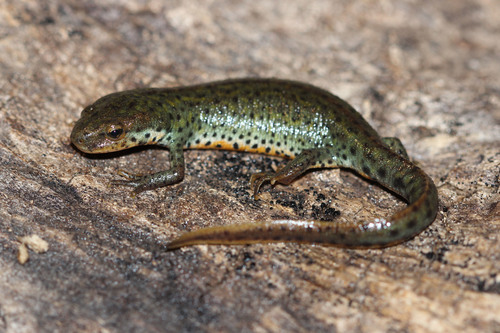
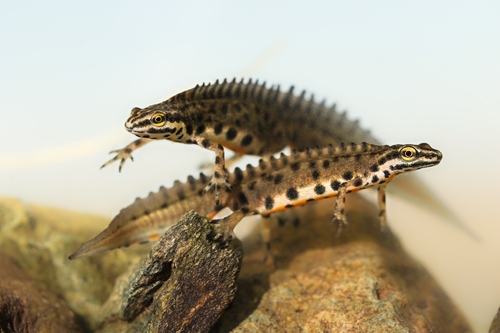
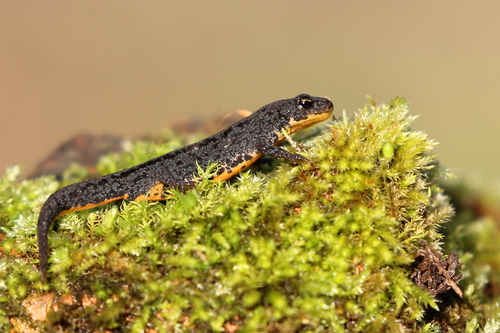
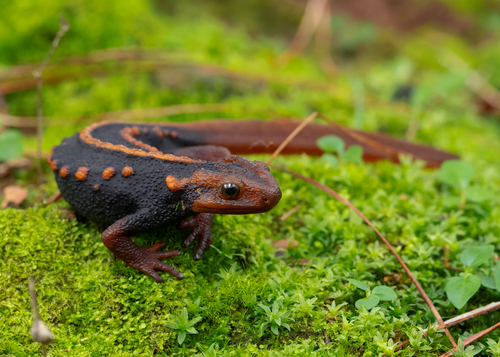
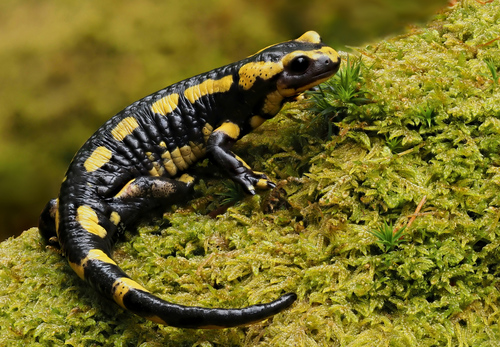
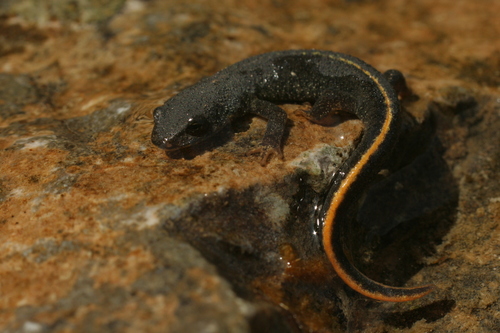
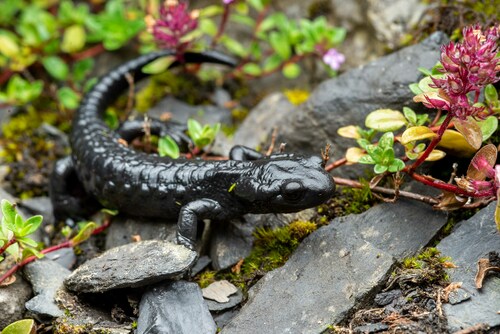
The alpine salamander, scientifically named Salamandra atra Laurenti, 1768, is typically small in size, with a base coloration of dark brown or black. Subspecies are not entirely monochrome black or brown, instead displaying mosaic or spotted patterns. The subspecies Salamandra atra aurorae has bright splotches on its dorsal side and head; these markings are most often bright yellow, but can also range into shades of white or gray. The distribution of this pigment depends on the arrangement of specific cells, so the markings may be smooth and even or uneven and patchy. Female alpine salamanders are usually larger than males, growing up to 151 millimeters (around 5.9 inches), while males reach approximately 144 millimeters (5.6 inches); both measurements include the tail. Males have swollen, visible cloacae and a more slender body shape than females. These salamanders have parotid glands located posterior and lateral to the eyes, which gives their heads an elongated shape. They typically have between 11 and 13 costal grooves along their body sides, and a double row of dorsal glands runs down either side of the spine, extending all the way to the tip of the tail. Alpine salamanders are fully terrestrial organisms that live on land. They usually shelter under stones or logs, or within rocky crevices in their mountainous habitat. They are primarily diurnal, meaning they are most active during the day and rest or are inactive at night, though they may become active at night depending on weather conditions. Ideal conditions for alpine salamanders are rainy or post-rain weather, with temperatures between 3 and 18 °C (37.4 and 64.4 °F). The geographic range of the alpine salamander extends from the France–Switzerland border at its western end, east through Austria to the Dinaric Alps at its eastern edge. This species typically occurs at altitudes above 700 metres (2,300 ft) above sea level, and can be found as high as 2,000 metres (6,600 ft) of elevation. A closely related species, Lanza's alpine salamander (Salamandra lanzai), inhabits a single small area of the western Alps in France and Italy. Alpine salamanders generally occupy forested biomes, particularly mixed deciduous-coniferous forests, and can also live in mountain meadows or grasslands, thriving in areas with a mix of tree types. Their range spans multiple countries: Slovenia, Croatia, Bosnia and Herzegovina, Montenegro, Kosovo, France, Italy, Austria, Algeria, and Switzerland. They thrive specifically in forest environments with silver fir and beech trees, and also survive well in coniferous forests with high proportions of Norway spruce and European larch, as they live on the forest ground floor. Because alpine salamanders are completely terrestrial, they maintain on-land territories that they return to throughout the day for refuge, and often return to the same sites for most of their lives. Leaving these sites exposes them to predation and increases their risk of losing the site entirely. Since alpine salamanders are ectothermic, they cannot internally regulate their body temperature, so losing a refuge or shelter can leave them exposed to unfavorable conditions and be extremely costly, even fatal. This high dependence on high-quality refuge sites supports the theory that many terrestrial salamanders, including S. atra, exhibit territorial behaviors. Data from capture-recapture studies shows the species is very stationary: the maximum distance recorded for an individual during the summer season was 12 metres (39 ft). Population counts in most suitable habitats find around 120 individuals per hectare, and counts of over 2000 individuals per hectare have also been observed, indicating this rather cryptic species is quite abundant. The sex ratio of alpine salamanders is 1:1. Mating occurs on land, with the male clasping the female at the forelegs, and fertilization is internal. S. atra is viviparous, meaning young are born alive and do not undergo metamorphosis unlike many other amphibians. Females give birth to 2 young, and sometimes 3 or 4. Newborn alpine salamanders can measure up to 50 millimetres (2 in) long at birth, even when the mother is only 120 millimetres (4.7 in) long. The uterus of a female alpine salamander is made up of a single luminal epithelial cell layer, connective tissue, and smooth muscle. Uterine eggs are large and numerous, but as a rule only one embryo fully develops in each uterus. The developing embryo is nourished by the yolk of the other eggs, which dissolve more or less completely to form a large mass of nutrient matter. This nutrient egg mass can reach 25 to 40 mm in length. The embryo goes through three distinct developmental stages. In the first stage, the embryo remains enclosed within its own egg and survives on its own yolk. In the second stage, the embryo is free within the vitelline nutrient mass, and eats the mass directly with its mouth. In the final third stage, the vitelline mass is completely consumed. At this stage, the embryo has long external gills that exchange nutritive fluid through the mother's uterus, functioning similarly to the chorionic villi of a mammalian embryo. Generally, at altitudes of 650–1,000 metres (2,130–3,280 ft) above sea level, pregnancy lasts two years; at altitudes of 1,400–1,700 m above sea level, pregnancy lasts around three years. Overall, gestation periods ranging from two to four years are considered standard. Alpine salamander embryos have a unique method of obtaining nutrients during their long gestation period. After the embryos have consumed the unfertilized eggs (a process called oophagy, covering stages 1 and 2), a portion of the mother's uterine wall provides nourishment. They then undergo epitheliophagy, the third stage, where they ingest cells from the mother's zona trophica uterine wall layer until birth. They have specialized tooth-like structures that allow this feeding without harming the mother.