About Sakesphorus canadensis (Linnaeus, 1766)
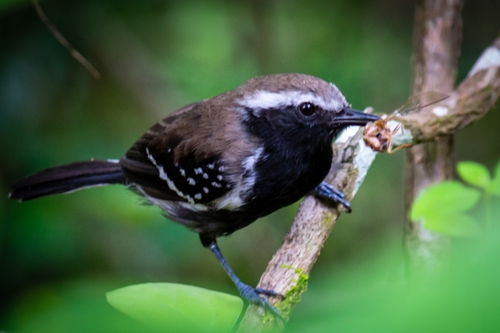
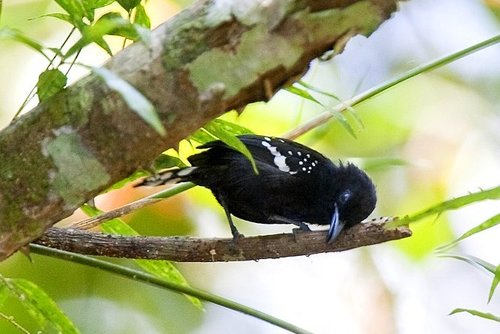
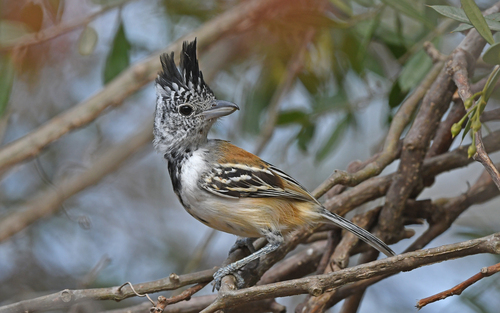
The black-crested antshrike (Sakesphorus canadensis (Linnaeus, 1766)) is 14 to 18 cm (5.5 to 7.1 in) long and weighs 20 to 28 g (0.71 to 0.99 oz). This species exhibits sexual dimorphism, but both sexes have a shaggy crest. Adult males of the nominate subspecies S. c. canadensis have a black head, throat, and center of the breast, plus a white band on the nape. Their upperparts are cinnamon-brown. Their wings and tail are black, with white edges on the feathers and white spots at the tips of the outer tail feathers. The sides of the breast and the belly are whitish gray, and the flanks and crissum are a darker gray. Adult females have a rufous crown, a grayish face, and cinnamon nape and sides of the neck. Their upperparts are cinnamon-brown, matching the male's. Their wings and tail are brownish black, with white edges on the flight feathers and white edges and tips on the tail feathers. Their throat is whitish, their breast is cinnamon with blackish streaks, and their belly and crissum are buff-tinged whitish. Subadult males resemble adult females. Other subspecies of the black-crested antshrike differ from the nominate subspecies and from each other as follows: S. c. pulchellus: compared to the nominate, males have white streaks on the black crown and throat, a speckled black and white face, lighter pale cinnamon upperparts, and more white on the tail and underparts; females are a paler version of the nominate. S. c. intermedius: very similar to the nominate. S. c. fumosus: generally darker than the nominate; males have almost black upperparts, very little white on the nape, slate-gray underparts, and little white on the tail; females are dark with heavy streaks on the breast. S. c. trinitatis: very similar to the nominate. S. c. loretoyacuensis: much like fumosus, except the male's nape and underparts are almost identical to the nominate's. The black-crested antshrike has a disjunct distribution, with subspecies occupying separate ranges as follows: S. c. pulchellus: Caribbean slope of northern Colombia from Chocó Department northeast into extreme northwestern Venezuela. S. c. intermedius: eastern Colombia from Arauca to Vichada departments, east through much of Venezuela and into the upper Branco River basin in northern Brazil. S. c. fumosus: southern Amazonas state in southwestern Venezuela. S. c. trinitatis: from Anzoátegui in northeastern Venezuela east into Guyana, and also on Trinidad. S. c. canadensis: Suriname and coastal French Guiana. S. c. loretoyacuensis: extreme southeastern Colombia and along the Negro, lower Branco, and upper Amazon rivers in northwestern Brazil, and separately along the upper Amazon and lower Marañón and Ucayali rivers in northeastern Peru. The provenance of a specimen recorded as collected in southern Pará, Brazil, is disputed, as there are no other records of the species that far south and east of the upper Amazon. The "streak-fronted" pulchellus subspecies of the black-crested antshrike inhabits deciduous and savanna woodlands, gallery forest, and bushy areas in semi-arid regions. The other subspecies occupy these same habitats, and also occur at the edges of igapó and várzea forest. The species also occurs locally in mangroves and dune scrub near the Caribbean coast. All subspecies are found mostly in the understorey and mid-storey of forests, and can also be found in gardens and city parks. In terms of elevation, the species occurs as high as 900 m (3,000 ft); it only reaches 400 m (1,300 ft) in Colombia, and 700 m (2,300 ft) in Venezuela.