About Saimiri oerstedii (Reinhardt, 1872)
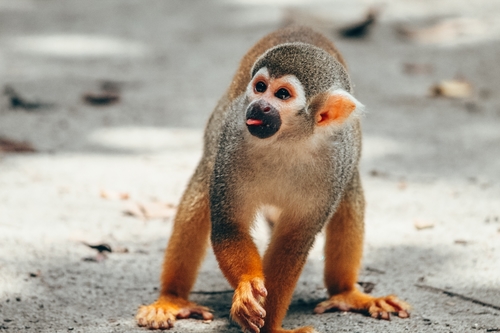
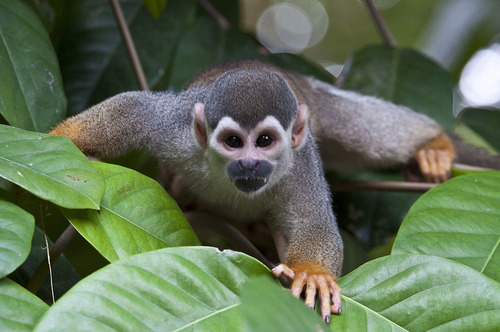
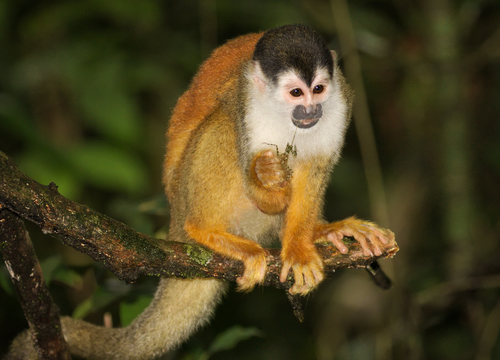
The Central American squirrel monkey, with the scientific name Saimiri oerstedii, differs in coloration from South American squirrel monkeys. While South American squirrel monkeys are primarily greenish, the Central American species has an orange back, olive-colored shoulders, hips and tail, white undersides, and orange hands and feet. It has a black cap on the top of its head and a black tail tip, and males generally have lighter caps than females. Its face is white, with black rims around the eyes and black coloration around the nose and mouth. The two recognized subspecies have similar overall coloration, but differ in the shade of the head cap. The northern subspecies, native to Central Pacific Costa Rica, has a lighter cap than the southern subspecies, which lives in Panama and parts of Costa Rica near the Panama border. The southern subspecies also has more yellowish limbs and underparts. For adults, body length excluding the tail ranges from 266 to 291 millimeters (10 1⁄2 to 11 1⁄2 inches), body weight ranges from 600 to 950 grams (21 to 34 ounces), and the tail is longer than the body, ranging from 362 to 389 mm (14 1⁄4 to 15 3⁄8 inches) in length. Like other squirrel monkeys, this species shows considerable sexual dimorphism: on average, males weigh 16% more than females, with an average body weight of 829 g (29 1⁄4 oz) for males and 695 g (24 1⁄2 oz) for females. Squirrel monkeys have the largest brains relative to body size of any primate; the Central American squirrel monkey's brain weighs approximately 25.7 g (29⁄32 oz), equal to about 4% of its total body weight. Unlike larger related monkey species such as capuchin, spider and howler monkeys, Central American squirrel monkeys do not have a fully prehensile tail except when they are newborn infants, and their tail is primarily used to assist with balance. This squirrel monkey has a restricted distribution along the Pacific coast of Costa Rica and Panama, ranging from Central Pacific Costa Rica in the north through western Panama. It can be seen by visitors in two of Costa Rica's national parks, Manuel Antonio National Park and Corcovado National Park, but it is less commonly encountered there than the white-headed capuchin or mantled howler monkey. It inhabits lowland forests, and is restricted to secondary forests and partially logged primary forests. It requires forests with abundant low and mid-level vegetation, and has difficulty surviving in tall, mature, undisturbed forests that lack this vegetation. Its specialization for coastal lowland forest may explain its limited restricted distribution. The breeding season for Central American squirrel monkey occurs in September, and nearly all females enter estrus at the same time. One to two months before the breeding season starts, males become larger, a seasonal form of sexual dimorphism. This size increase is not caused by extra muscle mass, but by altered water balance within the male's body, triggered when the male hormone testosterone is converted to estrogen: more testosterone produced by a male leads to greater pre-breeding season size gain. Males within a social group have not been observed fighting for access to females or forcing females to copulate, so researchers believe female choice determines which males successfully breed. Females generally prefer males that gained the most size before breeding season; this preference may be because the most enlarged males are typically the oldest and most effective at detecting predators, or it may be an example of runaway intersexual selection. During the breeding season, males sometimes leave their group temporarily to attempt mating with females from neighboring groups. Females are receptive to外来 males from other groups, though resident males of the group try to repel these intruders. Gestation lasts six months, and all infants are born within a single week between February and March. Typically, only one infant is born per pregnancy. Only about 50% of infants survive longer than six months, mostly due to predation by birds. Infants stay dependent on their mother for approximately one year. Females give birth once every 12 months, so the previous infant becomes independent around the same time a new infant is born. Females reach sexual maturity at 2 1⁄2 years old, while males reach sexual maturity between 4 and 5 years old. When females reach sexual maturity, they leave their natal group; males almost always stay in their natal group for their entire lives. This pattern differs from South American squirrel monkey species, where either males disperse from their natal group, or both sexes disperse. Males of the same age tend to associate with each other in age cohorts. After reaching sexual maturity, an entire age cohort may leave their original group and attempt to oust males from another group to gain better reproductive opportunities. The lifespan of Central American squirrel monkeys in the wild is not known, but captive individuals have been recorded living more than 15 years. Other squirrel monkey species are known to live more than 20 years.