About Saimiri boliviensis (I.Geoffroy Saint-Hilaire & de Blainville, 1834)
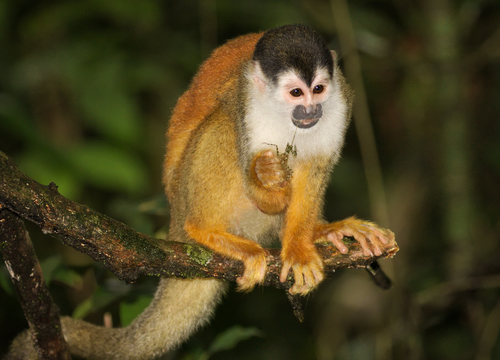
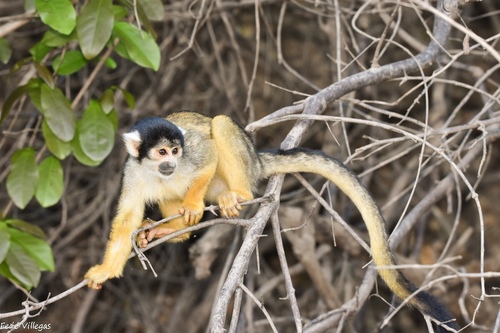
This species, Saimiri boliviensis, is commonly known as the black-capped squirrel monkey. It shows clear sexual dimorphism: adult males typically weigh between 550 and 1,135 g (19.4 and 40.0 oz), while adult females weigh between 365 and 750 g (12.9 and 26.5 oz). Newborn infants usually weigh between 80 and 140 g (2.8 and 4.9 oz). Head-to-tail-base length for adults ranges from 250 to 370 mm (9.8 to 14.6 in) for males and 225 to 295 mm (8.9 to 11.6 in) for females. The species' tail measures around 350 to 425 mm (13.8 to 16.7 in), matches the body's color, has a black tufted tip, and is not prehensile. The coat is short, soft, and dense. Most fur on the back ranges from grey to olive-brown, while the undersides are typically white, yellow, or ochre. The head is characteristically black, with white arches over the eyes. Black-capped squirrel monkeys are physically very similar to many other squirrel monkey species, but can be distinguished by several unique features. The most noticeable are its dark black cap and the white 'Roman type' arch pattern over the eyes, which is narrower and more rounded than the 'Gothic type' eye arch pattern found on other squirrel monkey species. The tails of 'Roman type' species, including this one, are also narrower than those of 'Gothic type' species. Black-capped squirrel monkeys with the characteristic 'Roman arch' facial pattern have been recorded across most of Bolivia, northern Peru, and the area between the Juruá and Purus Rivers in Brazil. This species lives in lowland tropical rainforests near water, in densely forested and swampy regions. It is predominantly arboreal; while it uses all forest levels, it has been observed to stay mostly in lower canopies for traveling and foraging. It has been proposed that matrilineal troops of Saimiri boliviensis form because their habitat has an abundance of fruit and insects, a resource level not seen in the habitats of other Saimiri genus species. Females of this species typically reach sexual maturation around 3 years of age, while males reach it around 5 years of age. Multiple researchers have observed that the yearly reproductive cycle of mature individuals is affected by several environmental factors, including rainfall cycles and illumination levels in their habitat. Mating season occurs during the dry season, and usually produces a single infant per mother. It has been suggested that adult females are more responsive to environmental cues that signal the start of mating season, and male response is partially attributed to behavioural and scent cues from females. During mating season, males gain a large amount of subcutaneous upper body fat, resulting in a distinct 'fatted' appearance. It has also been observed that testosterone levels in Bolivian and Peruvian populations of this species are noticeably higher during mating season than those of male Saimiri from Guayana. Males become more irritable and aggressive, fight more frequently to establish dominance within the troop, and perform genital displays toward less dominant males. Observations in both natural and laboratory settings show that troop hierarchy can change as often as three times per month. These changes often lead to highly aggressive fights that may result in younger adult males being fully excluded from the troop. A male uses female scent and behavioural cues to judge whether a female will be receptive to his mating approach. If the female is not receptive, she will usually chase the male away, sometimes with help from other nearby females. Consorting and copulation can last between one minute and over an hour, depending on the presence of other monkeys and the surrounding environment. The gestation period is estimated to last between 160 and 170 days. During the first week after birth, an infant clings to its mother's back, rarely moves, and is only attended to by the mother when it needs assistance. Black-capped squirrel monkeys are omnivorous. Their typical diet includes fruits, insects, eggs, small vertebrates, arachnids, leaves, flowers, nuts, and seeds; fungi are consumed rarely. They have been observed to prefer insects over fruit. Mature individuals spend most of the day foraging. They begin foraging 40 to 60 minutes before sunrise, spending the first part of the day actively feeding on fruits and any insects they catch while foraging for fruit. They then shift to slower feeding behaviors, spending the rest of the day resting and hunting for additional insects. When food is not scarce, they will stop to rest for an hour or two around midday when temperatures are too hot for continued activity. When fruits are scarce during dry seasons, squirrel monkeys have been reported to consume Ascopolyporus, a fungus that parasitizes scale insects, which themselves parasitize local bamboo species. Researchers hypothesize this fungus acts as an alternative food source during dry seasons.