About Saguinus imperator (Goeldi, 1907)
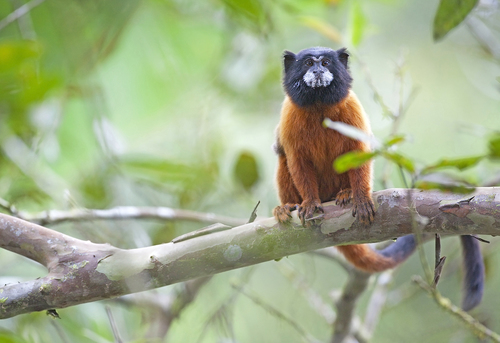
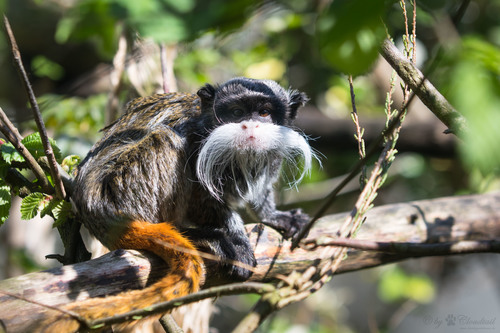
Emperor tamarin, scientifically named Saguinus imperator (Goeldi, 1907), has claws on all fingers and toes except the big toe, which bears a nail. It is distinguished by a prominent long mustache, with faint, almost unnoticeable white hairs on its chin. The fur on its chest and belly is a mix of red, orange, and white; its back fur is dark brown, and the inner surfaces of its arms and legs are orange-toned. Compared to most other primates, emperor tamarins are very small. They use their claws to cling to tree branches, staying primarily oriented vertically in the jungle environment. They navigate their typically rainforest habitat by leaping and moving quickly through trees, and rarely descend to the forest floor. Emperor tamarins live mostly in Amazonian lowland rainforests, lower mountain rainforests, and also occur in remnant, primary, and secondary forests. Amazonian lowland forests have abundant water during high water periods from flooding by nearby water sources, creating a consistently humid tropical climate year-round. The lower montane forests they inhabit are also tropical and moist with abundant vegetation. Flowering peaks during the dry season and declines in the wet season, which affects the emperor tamarin diet. Around 40% of the total forest area where emperor tamarins live is secondary forest, where many emperor tamarins are found. Secondary forests accumulate woody plant species at a relatively rapid rate, though the mechanisms behind this are complex and no clear pattern has been identified, and this process supports growth of the trees that emperor tamarins primarily occupy in secondary forests. Emperor tamarins live in social groups with an average size of 2 to 8 individuals, though group sizes can range from 4 to 18. Groups are structured as extended family units, and usually contain only one breeding female. Groups most often consist solely of emperor tamarins, but occasionally include saddle-back tamarins when their foraging groups join together. This mixed grouping is tied to differing canopy preferences: emperor tamarins typically stay above 10 meters (33 ft) in the canopy, while saddle-back tamarins usually stay below 10 meters. Emperor tamarins have a broad daily diet. They eat fruits and flowers, which are abundant in their vegetation-rich habitats. They also consume plant exudates such as gums and saps, which they easily gouge from the trees they inhabit. Many also eat animal prey including insects and frogs, depending on the type of forest they occupy. Emperor tamarins are recorded to form mixed-species foraging associations with Weddell's saddle-back tamarins (S. fuscicollis weddelli), and spend up to 20% of their day foraging in these mixed troops. Emperor tamarin society follows a dominance hierarchy led by a dominant female and her mate. Dominant individuals form these foraging troops, and forming mixed-species groups benefits emperor tamarins by improving their ability to find high-quality food resources. It was once speculated that female emperor tamarins were the primary foragers for fruit and flowers, because of a supposed stronger visual ability compared to males. Research has found that males and females have equal ability to locate food patches. The mistaken speculation arose because females tend to be more dominant hunters, even though there is no difference in food-locating skill between the sexes. Weddell's saddle-back tamarins are faster and more effective at locating food resources. As a smaller-bodied tamarin species, they can move quickly through the canopy, and often reach food resources before emperor tamarins. Emperor tamarins follow saddle-back tamarins to food patches, then use their larger size to intimidate the feeding Weddell's saddle-back tamarins into leaving the feeding tree. This foraging strategy benefits both species, as mixed-species troops provide better vigilance against predators. Observations of foraging mixed troops at feeding platforms and fruiting trees show that these troops spend less time foraging in small fruiting tree patches with limited fruit resources. The emperor tamarin is distributed in Brazil, parts of Peru and Bolivia that fall in the southwest Amazon Basin, east of the upper Purus River, between the Purus River and Rio Acre, east of the upper Juruá River to the Tarauacá River and Jurupari River, west to the Urubamba River and Inajá River, and south of the Tahuamanu River. According to Buchanan's research, the subspecies S. imperator imperator is rarely found in Los Campos and Buena Vista near the left bank of the Rio Acre, and also occurs on the banks of the Purus River and Eiru River. According to Buchanan and Bairrao, the subspecies S. imperator subgrisescens is found on the upper banks of the Juruá River, south of the Tahuamanú River, and along the banks of the Muyumanu River. For reproduction and infant care, emperor tamarins reach sexual maturity and first reproduce at around 16 to 20 months old, and have a gestation period of up to 6 months. They are seasonal breeders, and breeding timing aligns with food availability. Most births take place in the wet season, when food resources are most abundant. Tamarin species were once thought to be monogamous, but wild observations of emperor tamarins show they have a polyandrous mating system: one dominant female mates with multiple males. This system works to ensure paternal investment in offspring. If a female mates with multiple males and gives birth to a litter, each male is more likely to invest in caring for infants, because any infant could potentially carry his genes into the next generation. Emperor tamarins frequently have twins or multiple births, so parental care and paternal investment are critical for infant survival. Early knowledge of tamarin infant care came only from captive studies of cotton-top tamarins (S. oedipus), which showed that infant survival depends on helpers. Helpers are either older female offspring of the dominant female that remain in their natal group, or males that frequently interact with the dominant female. Carrying infants has a high energetic cost, because infant weight is relatively large compared to adult weight. Helpers offset some of this cost for caring for multiple infants. In emperor tamarins, males have been observed to spend the most time with infants, often carrying both infants while the dominant female forages. Male emperor tamarins are reported to be more watchful of infants and more protective; for example, they react faster to infant distress calls than females do. The highest rate of wild infant mortality occurs between 5 and 15 weeks of age, when infants begin moving and exploring on their own. The main threat to infant survival at this stage is falling from the canopy.