About Saguinus geoffroyi (Pucheran, 1845)
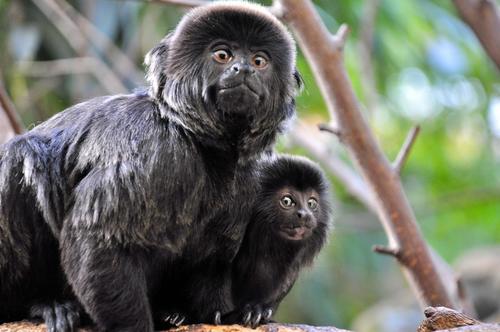
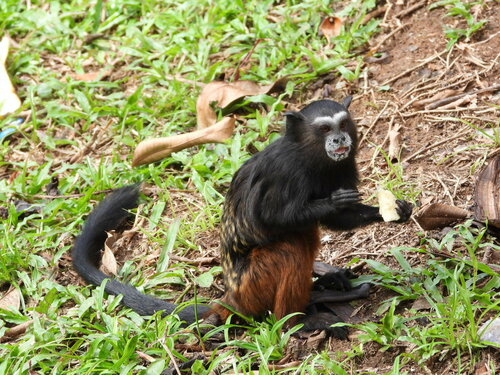
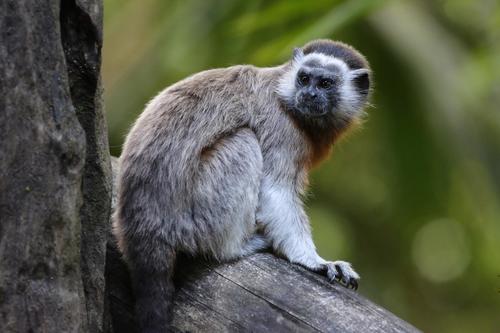
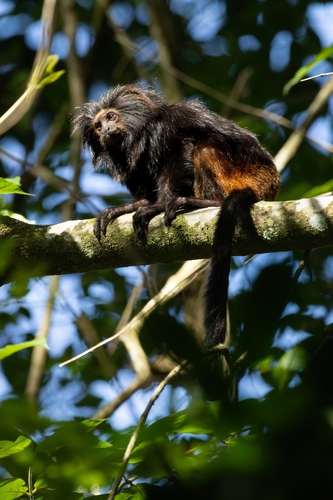
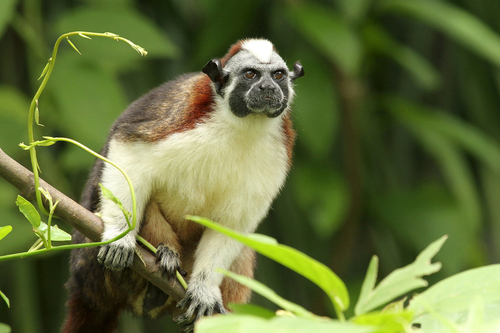
Geoffroy's tamarin, with the scientific name Saguinus geoffroyi (Pucheran, 1845), is a small New World monkey that shares key traits with other callitrichids (tamarins and marmosets). Excluding its tail, it measures between 225 and 240 millimeters (8.9 and 9.4 inches) long, making it the smallest monkey native to Central America. Its tail ranges from 314 to 386 millimeters (12.4 to 15.2 inches) in length. On average, males weigh 486 grams (17.1 oz), while females are slightly larger, with an average weight of 507 grams (17.9 oz). Its back fur is a variegated mix of black and yellow, and its legs, feet, and chest are pale. Its face is nearly hairless, but its head has reddish fur with a triangle-shaped patch on the front of the head. Its tail is chestnut-red with a black tip. This species occupies multiple forest types, including primary forest, secondary forest, dry tropical forest, and moist tropical forest. In Panama, it prefers moderately humid secondary forests. Its range in Panama covers central and eastern parts of the country, extending slightly west of the Panama Canal zone, and individuals have been observed as far west as Altos de Campana National Park. It is less common on Panama's Atlantic coast than on the Pacific coast, and it is only abundant on the Atlantic coast in human-modified areas near the Canal zone. It also lives in Metropolitan Natural Park, an urban park located within Panama City. In Colombia, Geoffroy's tamarin occurs on the Pacific coast west of the Andes, extending south to the Rio San Juan. Its range's eastern boundary in Colombia was originally thought to be the Rio Atrato, but the species has since been recorded further east, including in Las Orquídeas National Natural Park. Older sources sometimes list this species as occurring in southern Costa Rica, but these records are most likely incorrect. Geoffroy's tamarin can give birth at any time of year, but its birthing season peaks between April and June. Births can be of a single infant or twins, though one twin often dies within the first few months of life. The gestation period is thought to be around 145 days, which is similar to that of the cottontop tamarin. The time between successive births ranges from 154 to 540 days, with an average of 311 days; longer interbirth periods occur after twins are born. Infants weigh between 40 and 50 grams (1.4 and 1.8 oz) and are born fully furred. Infant fur differs in color from adult fur: infants have black fur on their body and tail, with a beige facial blaze and a white face. This distinct infant coloration reduces the visibility of white, a color linked to aggressive displays in the species. Geoffroy's tamarin practices both polyandrous and polygynous mating, and males contribute significantly to parental care. Typically, only one adult female in a social group is reproductively active, and reproductively active females will mate with multiple males when given the opportunity. Males carry and groom infants more often than females do. Older siblings may also help care for infants, though infants prefer being carried by their parents over their siblings. Infants become mobile at 2 to 5 weeks old, and start eating solid food at 4 to 7 weeks old. They become independent at 10 to 18 weeks old, and are fully weaned between 15 and 25 weeks old. Geoffroy's tamarin reaches sexual maturity around 2 years of age, and can live up to 13 years.