About Sagittaria longiloba Engelm. ex J.G.Sm.
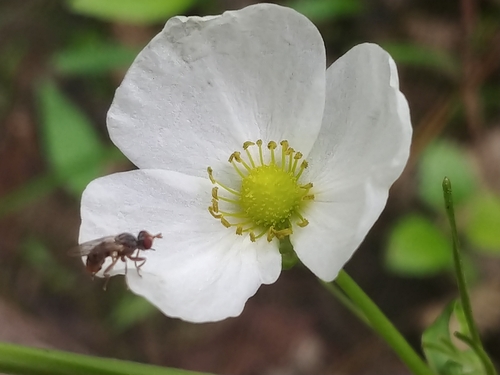
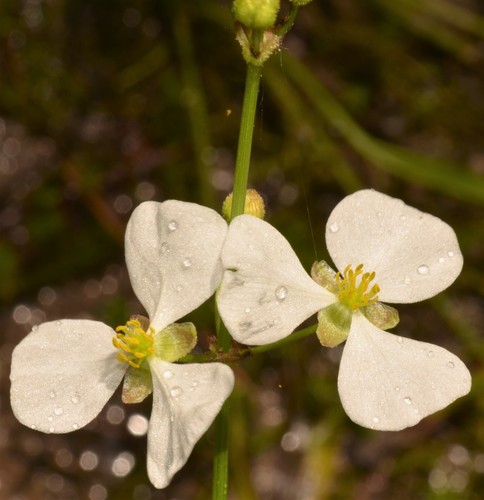
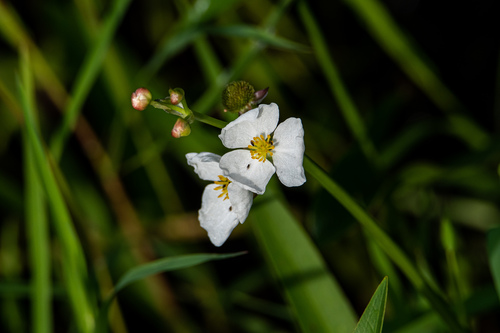
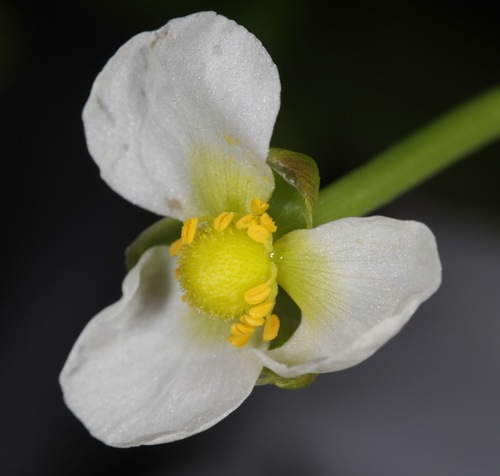
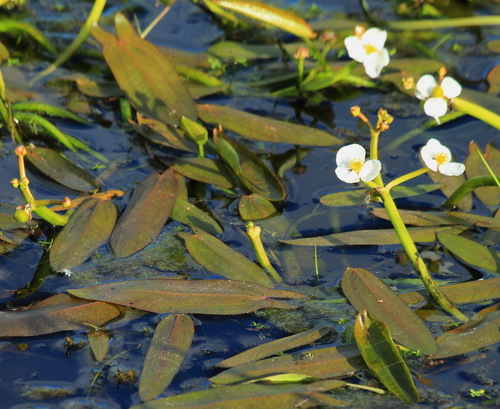
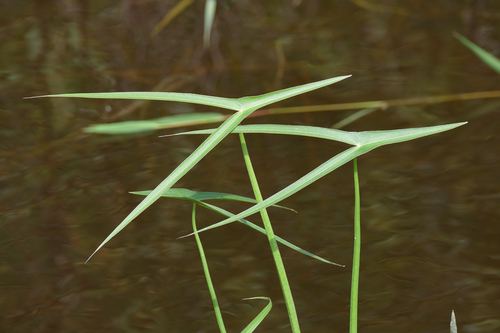
Sagittaria longiloba Engelm. ex J.G.Sm. is a perennial aquatic plant that grows from a spherical tuber. Its leaves are sagittate, meaning arrowhead-shaped, with two longer, narrower, pointed lobes opposite the shorter tip. Leaf blades are borne on very long petioles. The species is monoecious, with each individual plant bearing both male and female flowers. The inflorescence rises above the water surface, forming a raceme made of several whorls of flowers; the lowest node holds female flowers, while upper nodes hold male flowers. Flowers can be up to 3 centimeters wide, with three white petals. Male flowers have rings of stamens at their centers. Each female flower has a spherical cluster of pistils that develops into a head of tiny fruits. It is native to south-central and southwestern United States (Texas, New Mexico, Oklahoma, Kansas, Nebraska, Arizona and California), as well as Mexico, Venezuela and Nicaragua. It is also reportedly naturalized in the western Himalayas of India and Bhutan. It grows in slow-moving, stagnant, and ephemeral water bodies such as ponds and small streams, and sometimes grows in disturbed and cultivated habitats like rice fields and irrigation ditches.