About Sagittaria latifolia Willd.
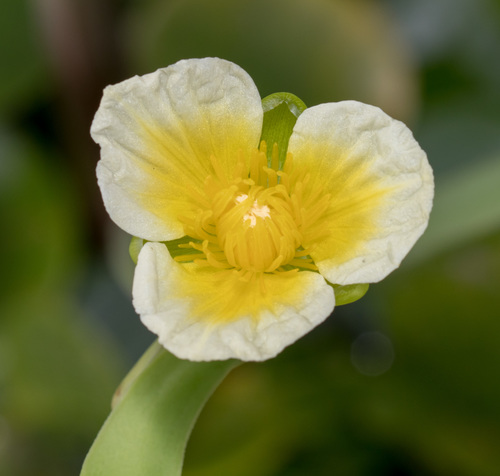
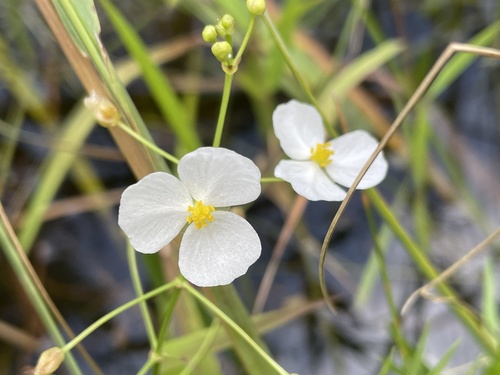
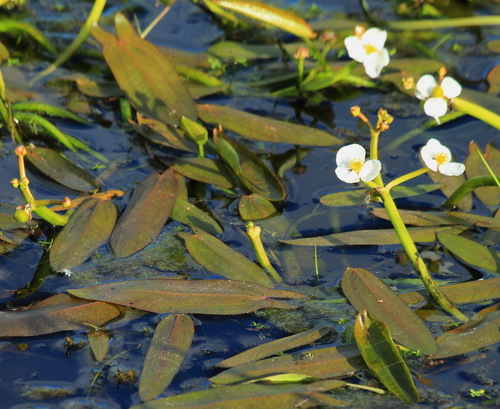
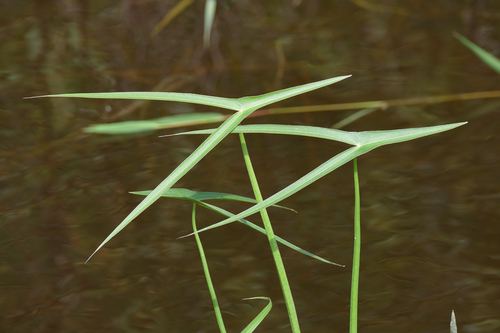
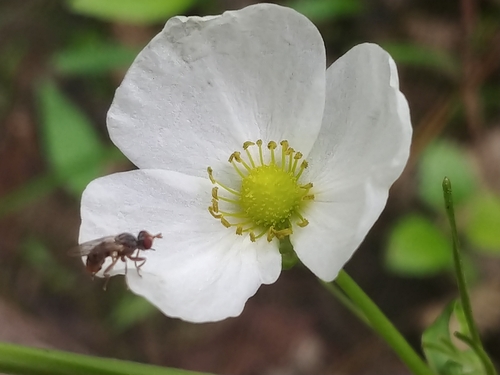
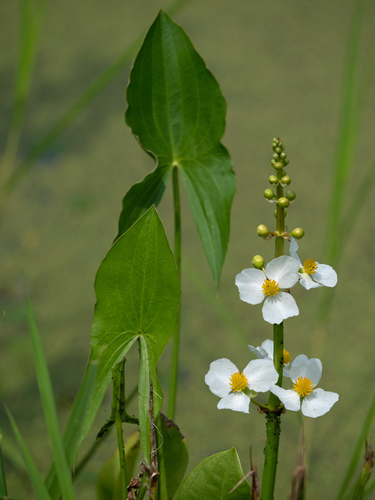
Sagittaria latifolia Willd. is a perennial plant that varies in size. It can reach a maximum height of 150 centimeters (5 feet), but grows more typically to between 60 and 120 centimeters (24 to 47 inches). These plants often grow close together in dense colonies, spreading via runners called stolons that grow at or just beneath the soil surface. In late summer, the plants produce tubers that are twice as long as they are wide, with each tuber typically measuring 0.5 to 5 cm (1⁄4 to 2 inches) in diameter. This species produces rosettes of leaves, plus an inflorescence carried on a long rigid scape. Its leaves are extremely variable: they range from 10 to 50 cm (4 to 19+1⁄2 inches) in length and 1 to 2 cm (1⁄2 to 3⁄4 inches) in width, and may be thin or wedge-shaped, similar to the leaves of Sagittaria cuneata. The leaves are spongy and solid, with parallel venation that converges at the center and the leaf tips and edges. The inflorescence is a raceme that sits about 90 cm (35 inches) above water, made up of white flowers arranged in whorls of three. Flowers bloom from July to September, and are around 2–4 cm (3⁄4–1+1⁄2 inches) wide. Usually, female flowers grow on the lower section of the inflorescence and male flowers grow on the upper section, though some individual plants are dioecious, with separate male and female individuals on different plants. Each flower has three round, white petals and three very short, curved, dark green sepals. Flower sex is easy to distinguish: male flowers have 25 to 50 yellow stamens, while female flowers have a spherical cluster of green carpels that can sometimes contain over a thousand carpels. Sagittaria latifolia is native to southern Canada, most of the contiguous United States, Mexico, Central America, Colombia, Venezuela, Ecuador, and Cuba. It is also naturalized in Hawaii, Puerto Rico, Bhutan, Australia, and much of Europe, including France, Spain, Italy, Romania, Germany, Switzerland, the Czech Republic, and European Russia. In Mexico, it has been recorded in Campeche, Nayarit, Tabasco, Tamaulipas, Puebla, Jalisco, Durango, Tlaxcala, Estado de México, Veracruz, and Michoacán. It grows in wet habitats such as ponds and swamps. As an extremely common emergent plant, broadleaf arrowhead forms dense colonies on very wet soils; these colonies become more open when the species grows alongside other plant species that occupy deeper water levels. The colonies form long bands that follow the curves of rivers, ponds, and lakes, and are clearly marked by the dark green color of the plant's leaves. It has strong roots, and can survive large fluctuations in water level, slow water currents, and waves. It prefers habitats with high phosphate levels and hard water. Despite its common name "duck potato", ducks rarely eat this plant's tubers, which are usually buried too deep for ducks to reach, though ducks often eat its seeds. Beavers, North American porcupines, and muskrats eat the entire plant, including the tubers. It has been reported that Native Americans would dig open muskrat houses to collect the stored roots the muskrats had gathered. This species is vulnerable to infestation by aphids and spider mites. Sagittaria latifolia is easy to cultivate in water 0.15 to 0.45 m (6 to 17+1⁄2 inches) deep, with no or very slow current. Tubers are planted spaced widely, with no more than 12 plants per square meter, at the end of May at a depth of 5 to 7 cm (2 to 3 inches). The crop is fertilized with decomposed manure. Plants can be propagated by seeding or by division in July. The starchy tubers, produced by rhizomes beneath the surface of wet ground, have long been an important food source for indigenous peoples of the Americas, alongside the tubers of S. cuneata. Tubers can be dug out of the ground in several ways: using feet, a pitchfork, or a stick. After digging, the tubers usually float to the surface. Ripe tubers are collected in autumn, and are often found floating freely at this time. The starchy tubers were eaten by Native Americans in the lower Columbia River basin, as well as by the Omaha and Cherokee nations. Tubers can be eaten raw, or cooked for 15 to 20 minutes. Their flavor is similar to that of potatoes and chestnuts, and they can be prepared in the same ways, such as roasting, frying, and boiling. They can also be sliced and dried to make flour. Late summer buds and fruits are also edible parts of the plant.