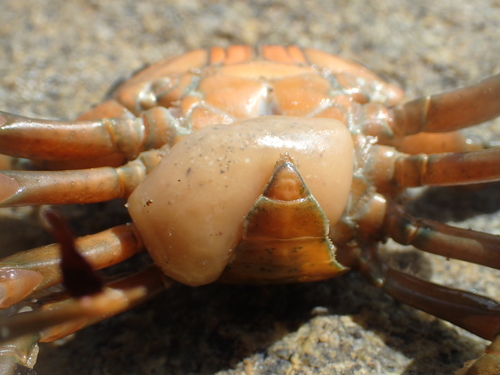
About Sacculina carcini Thompson, 1836
Sacculina carcini, commonly called the crab hacker barnacle, is a species of parasitic barnacle in the family Sacculinidae. It acts specifically as a parasitic castrator of crabs, with the green crab being its most common host. The natural range of the green crab is the coasts of Europe and North Africa. The barnacle attaches to the crab's abdomen, and its presence impacts human consumption of infected crabs. Sacculina carcini is a monoxenic parasite of crabs. Beyond the most common host Carcinus maenas (the green crab), it has also been found infecting Carcinus aestuarii, Liocarcinus depurator (harbour crab), Pirimela denticulata, Necora puber (velvet crab), and Liocarcinus holsatus (flying crab). The natural range of the parasite largely matches the range of its primary host, the green crab, covering the coasts of Western Europe and North Africa. Because the green crab has expanded its range and established populations in North America, South America, Southern Africa, and Australia, the parasite may now exist outside of its original natural territory. All of the crab species it infects live in shallow water on substrates that are sandy, rocky, or muddy. The life cycle of Sacculina carcini begins when a female larva settles on a suitable crab host and crawls across the crab's surface to find a spot like the base of a bristle (seta). It then develops into a form called a kentrogon. Before inserting a stylet into the crab to push itself inside the host, the female larva sheds its outer hard shell. Once inside the crab's body, it eventually grows an external sac called an externa on the underside of the crab's abdomen. The internal portion of the parasite, called the interna, develops spreading tendrils that extend throughout the crab's body. These tendrils grow into the crab's stomach, intestines, and nervous system to absorb nutrients and allow the parasite to control its host's behavior. The presence of the parasite stops the development of the crab's gonads, which eventually waste away. It also prevents the crab from molting, which means the crab cannot regenerate any lost limbs. Infection causes male crabs to develop feminine traits, including a broader abdomen. In infected female crabs, the abdomen narrows, and the pleopods (abdominal appendages) degenerate. The parasite's eggs develop inside the externa. Both infected male and female crabs carry these eggs under their abdomens, a form of brood care that is normally only done by female crabs, never by males. If the parasite is experimentally removed from an infected host, female crabs usually regenerate their ovaries, but infected males undergo sex change and develop ovarian tissue. Eggs inside the externa are fertilized by tiny male larvae that enter the sac through a pore. These tiny males never develop into adults and die shortly after fertilization. The female parasite, including its externa, can live for as long as the crab host survives, typically one to two years. Hundreds of eggs are produced every day, and they develop inside the externa for approximately six weeks. When the parasite's eggs are ready to be released, the infected crab climbs onto a rock, bobs back and forth, and releases the eggs to be carried away by water, and the life cycle repeats with the next generation.

