About Sabellaria alveolata (Linnaeus, 1767)
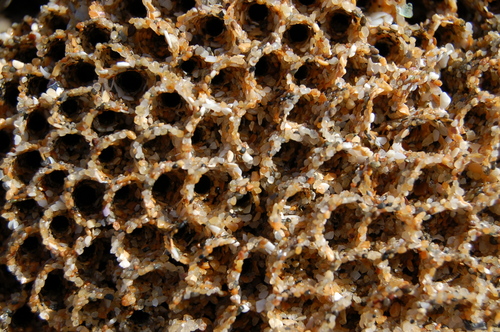
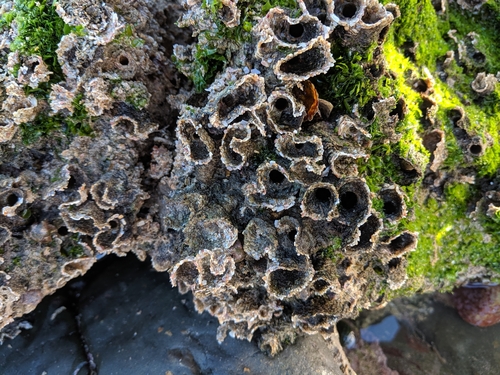
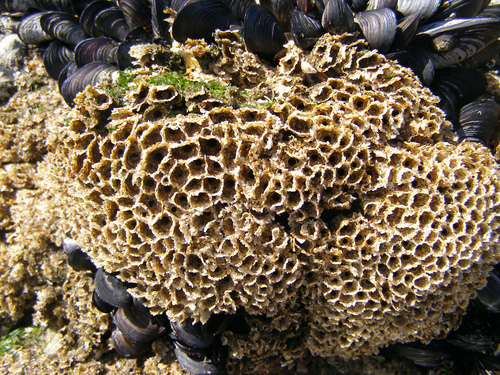
Sabellaria alveolata is an annelid, or ringed worm, that lives in small tubes it constructs from cemented coarse sand, shell material, or both, which aggregate to form reefs. The tubes sit close together and have a distinct honeycomb-like appearance. These reefs are between 30 centimetres (12 in) and 2 metres (6.6 ft) thick, and form as hummocks, sheets, or larger, more massive formations. Adult worms reach 30 to 40 millimetres (1.2 to 1.6 in) in length. The thorax holds three pairs of flattened chaetal sheaths, and its chaetes form an operculum that seals the tube opening when closed. The colour of the tube varies depending on the local substrate. This species is found in the Mediterranean and the North Atlantic, ranging from Britain south to Morocco. In Britain and Ireland, it occurs mainly in intertidal zones along southern and western coasts, from the Western Isles to Cornwall. Wicklow Reef, located in the Irish Sea at a depth of 12–30 metres (39–98 ft), is the only known subtidal Sabellaria alveolata reef off the coast of Britain and Ireland. Sabellaria alveolata inhabits roughly the bottom third of the intertidal zone and the shallow subtidal zone. The worms build different types of structures depending on local environmental conditions. On rocky shorelines among bladderwrack, low densities of the worms form thin encrustations of aggregated tubes, while high densities form dense hummocks and mounds. Tubes are constructed from shell fragments or sand, and protect the worm from predators; damage near the tube entrance can be repaired. Each tube is formed from multiple overlapping layers of material glued together with the worm’s mucus. This species has two separate sexes, and spawning occurs in both spring and autumn. Larvae develop in the water column, and can detect the binding substance adult worms use to build their tubes, following this cue to find a suitable settlement site. Sabellaria alveolata is a filter feeder that uses cilia-covered tentacles to extract food from the water. The reefs built by this species support increased biodiversity.