About Sabella spallanzanii (Gmelin, 1791)
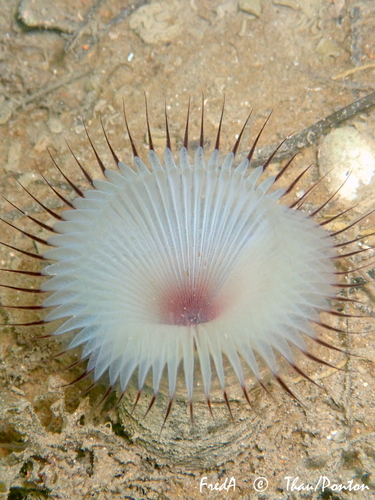
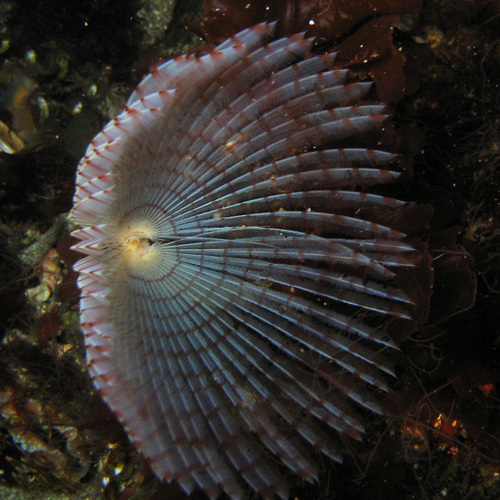
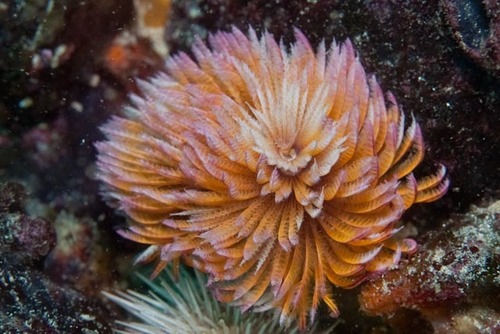
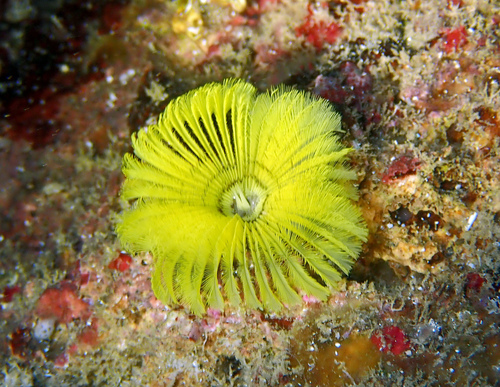
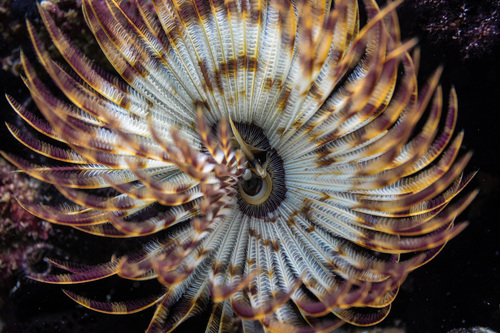
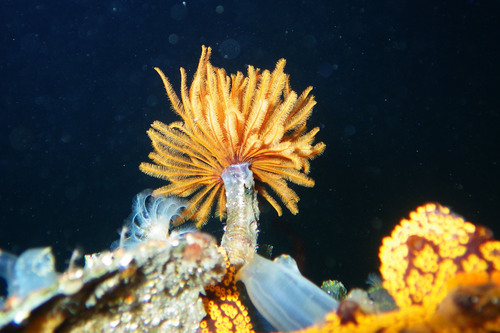
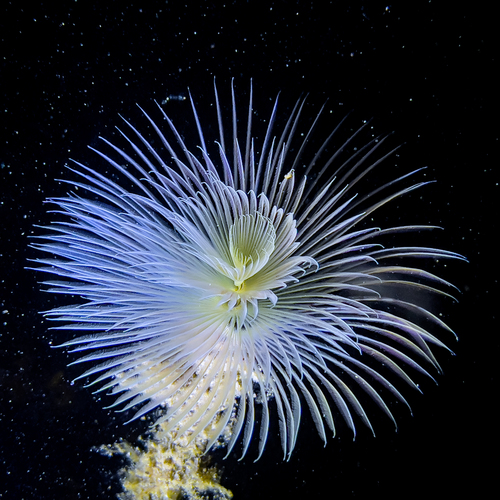
The European fan worm, Sabella spallanzanii, reaches a total length of 9 to 40 cm (4 to 16 in), and individuals are typically larger in deep water. This worm forms stiff, sandy tubes from its own hardened mucus; these tubes protrude from sand, and are often rather wrinkled near their bases, where various epiphytic organisms settle and grow. The worm has a two-layered crown of retractable feeding tentacles, with one layer forming a distinct spiral. Tentacle colour is variable, but most are banded with orange, purple and white, or a uniform pale grey. This species is native to the northeastern Atlantic Ocean, the North Sea and the Mediterranean Sea. Its native range extends from the United Kingdom and Ireland, through France, Spain and Portugal, to Italy, Greece and Turkey. It has also been recorded from South America and the southern African coast from Namaqualand to Port Elizabeth. It was first recorded in Western Australia in 1965, and has since spread to other parts of southern Australia; it was first spotted in New South Wales in 1996, and is classified as an invasive species in Australia. It first appeared in New Zealand in 2008, where it is considered a pest. European fan worms occur at depths up to 30 m (98 ft). They inhabit nutrient-rich waters in sheltered locations with no strong currents and minimal wave action. They grow on soft sediments, or anchor themselves to rocks, mollusc shells, jetties, pontoons, and other solid surfaces. They may grow on the hulls of moored boats, but do not typically foul vessels that are in frequent use. The European fan worm can bioaccumulate bacteria, and strongly impacts the marine bacterial environment. Microbes accumulate in the worm, reaching much higher concentrations in its tissues than in the surrounding water, so this species can be used as a bioindicator. It efficiently filters out Vibrio spp. bacteria, which are pathogenic to fish and shellfish, and can cause foodborne illness in humans. It also has potential use for remediation of polluted water near sewage outlets.