About Sabatia campestris Nutt.
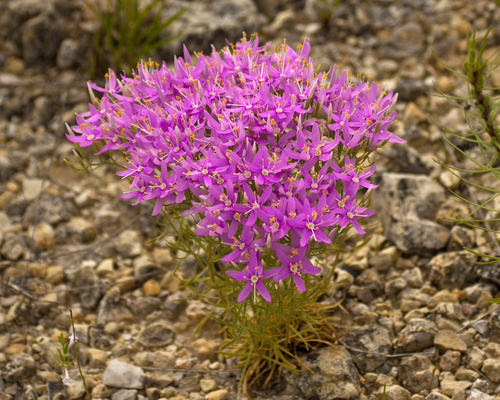
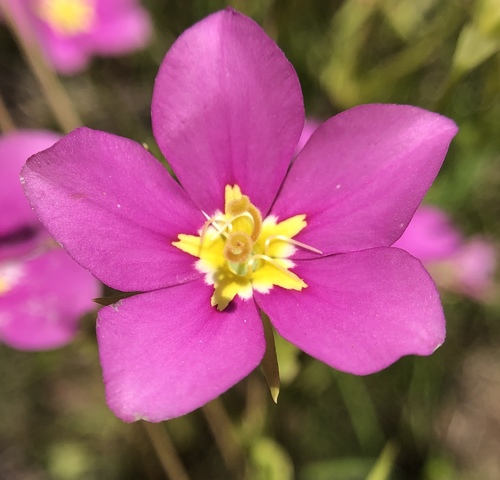
Sabatia campestris Nutt., commonly called Texas star, and also known as prairie rose-gentian, prairie sabatia, and meadow pink, is a species in the genus Sabatia. It is native to the south-central United States, ranging from Texas east to Mississippi and north to Iowa and Illinois, and is also locally naturalized in New England. This is an annual plant that grows 15 to 25 centimeters (6 to 10 inches) tall. It has pairs of opposite leaves that measure 8 to 40 millimeters long and 5 to 20 millimeters wide. Flowers are borne in open, long-stalked cymes at the tops of stems. The flower corolla is around 40 millimeters in diameter, with five lobes that are most often pink, and rarely white. The lobes have bluntly pointed tips, and the flower center has a contrasting bright yellow 'eye'. The flowers are hermaphrodite, containing both male and female reproductive organs. After flowering, it produces a capsule fruit that holds numerous small seeds. In its native range, this species grows in sandy prairies, woodland edges, and stream banks. Sabatia campestris is cultivated as an ornamental plant for gardens. In cultivation, it needs moist soil and partial to full sun. It has documented medicinal uses as an anti-periodic and a tonic, and a herbal tea can also be made from the plant.