About Sabal mexicana Mart.
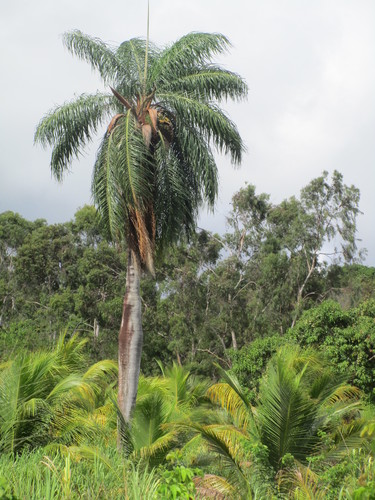
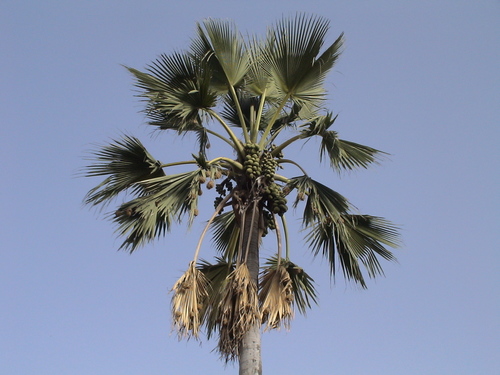
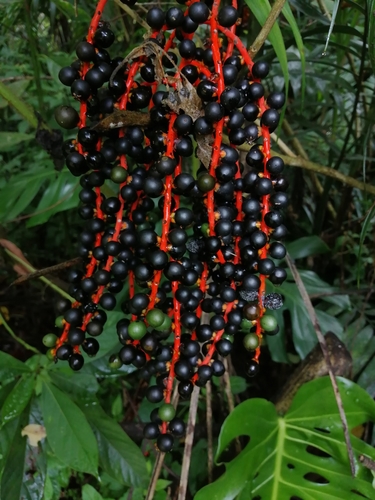
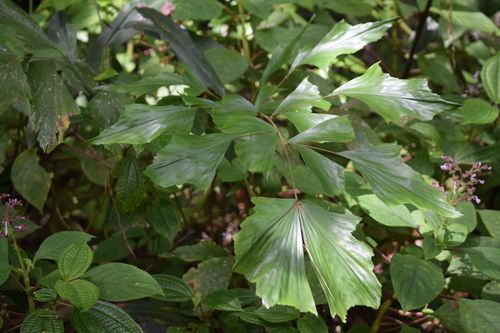
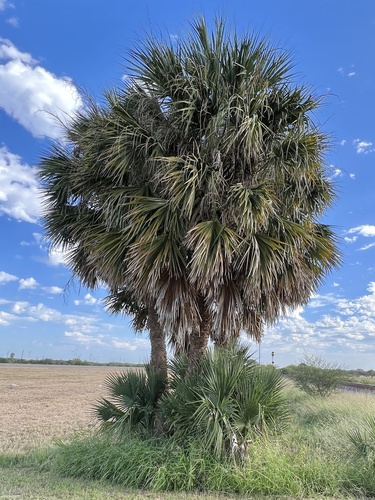
Mexican palmetto (Sabal mexicana Mart.) reaches a height of 12–18 m (39–59 ft), with a spread of 3–4 m (9.8–13.1 ft). Its trunk grows 12–15 m (39–49 ft) long and 30 cm (12 in) in diameter. The fan-shaped fronds are 1.5–1.8 m (4.9–5.9 ft) wide, and attach to 90–120 cm (35–47 in) spineless petioles. Spikes 1.2–1.8 m (3.9–5.9 ft) in length produce small bisexual flowers. When ripe, its drupes are black and measure 12 mm (0.47 in) in diameter. The current range of S. mexicana extends from South Texas on the Gulf Coast of the United States and Nayarit on the Pacific Coast, south along both coasts to Nicaragua. It is one of the most widespread and common palm trees in Mexico, where it grows in the drier lowlands. Some sources suggest the species may once have ranged much further north along the Texas Gulf Coast, and as far inland as San Antonio. This claim is supported by observations recorded between the 17th and 19th centuries, the presence of a small, disjunct population 200 mi (320 km) north of the Lower Rio Grande Valley, and the ease with which cultivated trees become naturalized in parts of Central Texas. S. mexicana should not be confused with the related, somewhat shorter "Brazoria Palm", which is a natural hybrid of S. palmetto and S. minor with a small population in southeast Texas. Naturally occurring S. mexicana in Texas may be hard to distinguish, because this palm is widely planted as an ornamental, and feral specimens easily establish themselves. Even so, at least two purely natural populations have been reported in Texas. The most prominent of these is located in the 557-acre Sabal Palm Sanctuary outside Brownsville, Texas, along the banks of the Rio Grande. The second is on a much smaller plot of land along the banks of Garcitas Creek, near Vanderbilt, Texas. Mexican palmetto is grown as an ornamental, valued for its robust, stately form, drought tolerance, and hardiness to USDA Zone 8. Its wood is resistant to decomposition and shipworms, so it is desirable for use in wharf pilings and fence posts. The leaves are used for thatching and for making straw hats. The drupes and palm hearts of this species are eaten.