About Saara hardwickii (Gray, 1827)
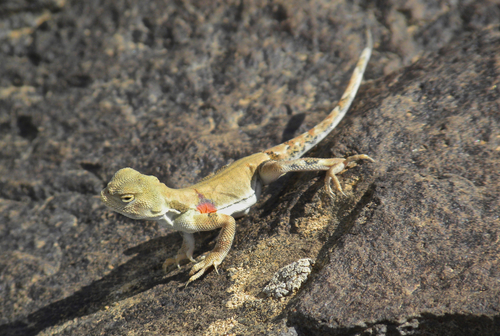
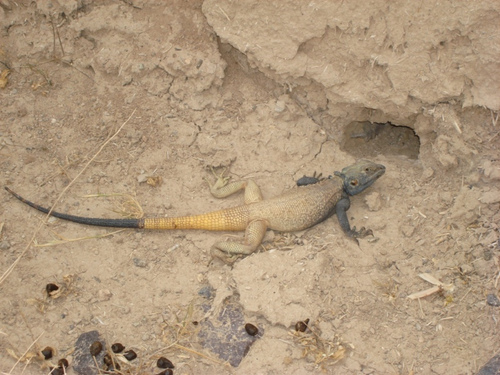
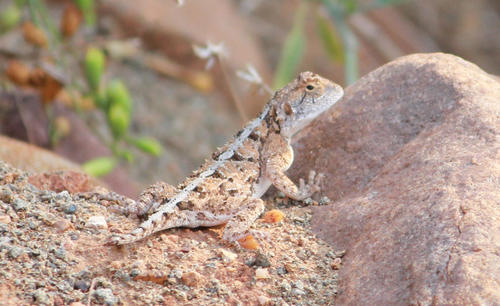
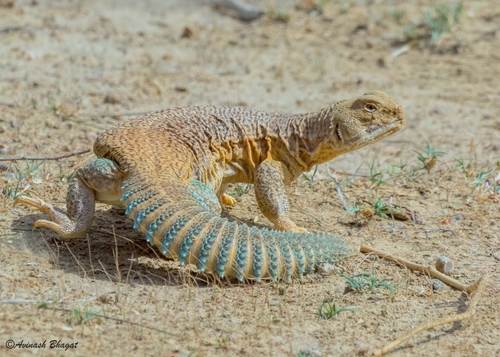
Hardwicke's spiny-tailed lizard, Saara hardwickii, has a rounded head with a flat snout. Its body color is most commonly yellowish brown, sandy, or olive. Individuals may have black spots, vermiculations, and a distinct black spot on the front of the thigh. It has a dorso-ventrally flattened body with wrinkled skin. Its tail features whorls of spiny scales, with large spines along the side. Tail color ranges from bluish-grey in specimens from Jaisalmer to sand-coloured in specimens from Kutch. The overall color of the lizard varies, with darker individuals appearing during colder seasons. The type locality for S. hardwickii is Kanauj district, Uttar Pradesh. It lives in dry desert tracts across the northern half of the plains of India extending into Pakistan. Its range stretches from Uttar Pradesh in the east westward to Rajasthan and the Kachchh area of Gujarat. The hot Thar Desert is this species' stronghold, and it is found extensively across the Jaisalmer, Bikaner, Barmer, and Churu districts of Rajasthan. It is also present in parts of Rewa, Madhya Pradesh, and in the Kohistan area of Sindh surrounding Karachi and Thana Bula Khan. This lizard generally inhabits firm ground rather than pure sand dunes, and is often found living in colonies, sometimes on the outskirts of villages. It prefers elevated patches of land; this is especially true in Kutch, where it is always found on isolated patches of high ground (called Bets) that lie above the monsoon water level. Hardwicke's spiny-tailed lizard is largely herbivorous, and its teeth are adapted for a plant-based diet. Its plant food includes the flowers and fruits of kair (Capparis aphylla), the beans of khejri (Prosopis spicigera), the fruit of Salvadora persica, and grass. In areas where locusts breed, this lizard is known to feed on both nymph and adult locusts. In summer, it tends to forage more actively in the mornings and feeds on insects to a greater extent, while during the monsoon it feeds mainly on herbs and grasses.