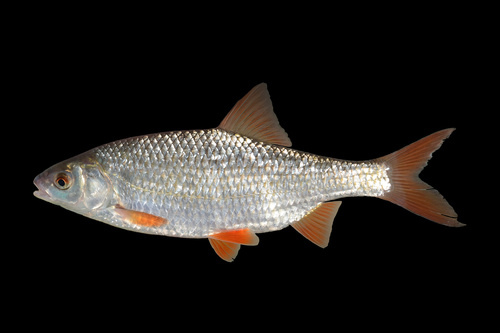
About Rutilus rutilus (Linnaeus, 1758)
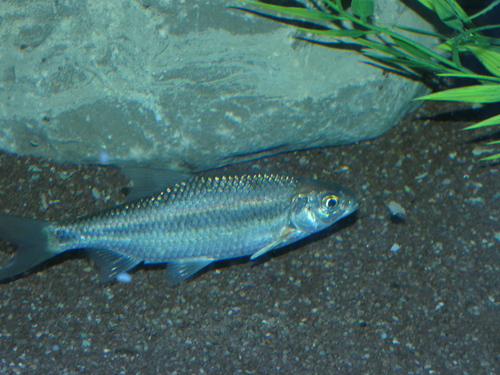
Rutilus rutilus, commonly called the common roach, is a small fish. Individuals most often reach no more than around 35 centimetres (14 in) in length, with a maximum recorded length of 50 cm (20 in). Its body has a bluish-silvery color that turns white on the belly, and all fins are red. There are 39–48 scales along the lateral line, and the dorsal and anal fins have 12–14 rays. Young common roach have a slender build, while older individuals develop a higher, broader body shape. The species can often be identified by a large red spot in the iris located above and beside the pupil; however, the colors of the eye and fins can be very pale in some environments. In Central and Northern Europe, the common roach is most easily confused with three other species: the common rudd (Scardinius erythropthalmus), the dace (Leuciscus leuciscus), and the ide (Leuciscus idus). It can be distinguished from these species through key characteristics. The common rudd has a more yellow-greenish or golden color, its dorsal fin is positioned further back, and only one or two scales sit between the tip of the ventral scales and the first ray of the anal fin, compared to four or five scales in the common roach. The common rudd also has a more upturned mouth and a sharper-looking head. The dace has a greenish body, colorless eyes and fins, and a distinct 'nose'. The ide has a higher number of lateral line scales (55–61), a rounder body, and a larger mouth and head. The common roach is found throughout Europe except for the area around the Mediterranean, and its range extends eastward into Siberia. Eastern Europe and Asia are home to several subspecies, some of which are oceangoing and live around the Caspian and Black Seas. Several closely related, non-overlapping species live around the Mediterranean, and in northwestern Spain and Portugal. The common roach was introduced to Australia from Europe in the 1860s and 1880s for sport, and now inhabits the Murray River and coastal drainages of southern New South Wales and Victoria. The common roach is highly adaptable, and can live in almost any freshwater ecosystem, from small ponds to the largest rivers and lakes. It feeds at all depths, though it prefers to find its food sources in shallower water. It tolerates organic pollution, and is one of the last fish species to disappear from polluted waters; it is also frequently the most abundant cyprinid in nutrient-poor waters. It can also tolerate brackish water, and survives in water temperatures from close to freezing at 4 °C (39 °F) up to around 31 °C (88 °F). Across most of its range, it is the most numerous fish species, but the common bream can surpass it in total biomass in water bodies with high turbidity and sparse vegetation. The common roach is a shoaling fish and is not highly migratory, with the exception of its oceangoing subspecies. During the cold season, common roach migrate to deeper water to feed, while they prefer to feed near the surface in warmer weather. They mostly live in somewhat vegetated freshwater ecosystems, because vegetation provides protection for larval and young fish, and mature fish can use vegetation as a food source. The common roach eats a wide variety of foods, including plant material, bottom-dwelling (benthic) invertebrates, worms, and maggots. Young fish feed mainly on plankton until they are large enough to use a broader diet. When invertebrates are scarce, common roach can adapt by slowing their growth, keeping their slender body shape, and maturing earlier. They may live for 15 years or more. Known parasites of the common roach include the fluke Rhipidocotyle campanula, the myxozoa Myxobolus muelleri, and the nematode Raphidascaris acus. The common roach's spawning season generally runs from March to June, with variation because spawning is triggered by rising water temperatures during spring and summer. Roach usually spawn at the same location every year. Large males form leks that females enter; males then trail females to fertilize their eggs. This spawning behavior is rough, and the fish often jump out of the water. A single female can lay up to 100,000 eggs. Common roach cannot reproduce successfully when the water pH is below 5.5.