About Russula xerampelina (Schaeff.) Fr.
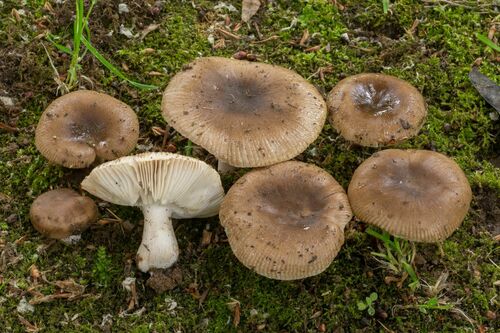
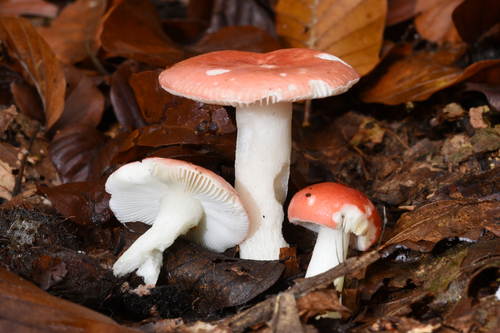
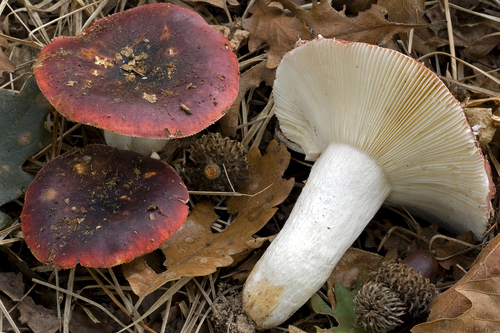
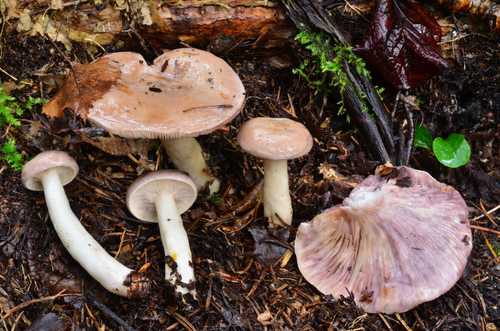
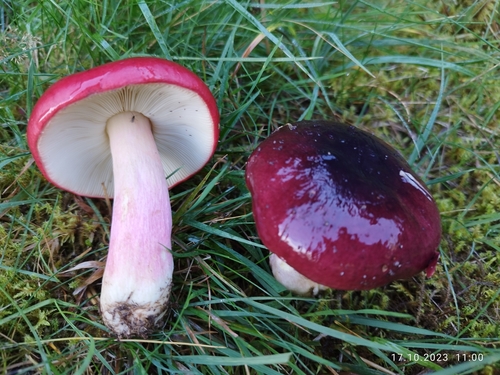
Russula xerampelina (Schaeff.) Fr. has a characteristic odor of boiled crab or shrimp. Trimethylamine and its precursor, trimethylamine N-oxide, cause this mushroom’s distinct smell. Its cap measures 5–20 cm (2–8 in) wide, and can be domed, flat, or have a slightly depressed center; the cap surface is sticky. Cap color is variable, most often purple to wine-red or greenish, and darker toward the cap center. Fine grooves up to 1 cm long run perpendicular to the cap margin. The stipe is 4–12 cm (1.5–4.5 in) long and 1.5–4 cm (0.5–1.5 in) wide, cylindrical in shape. It is white, sometimes with a reddish blush, and turns brown when bruised. The gills are narrowly spaced, have a taste that ranges from mild to rather bitter, and turn creamy-yellow as the mushroom ages. The spore print is creamy-yellow to ochre. The oval spores are 8.8–9.9 by 6.7–7.8 μm, and covered with 1 μm spines. Some mycologists have split this species into several similar species. All of these related taxa share two consistent traits: they produce a distinct dark green color reaction when iron salts (iron(II) sulfate) are applied to the flesh, and they all have the characteristic shellfish odor. This aroma is quite distinct and becomes stronger as the mushroom ages. Russula xerampelina is widely distributed. It is quite common in northern temperate zones, often ranges into the Arctic Circle, and also extends south as far as Costa Rica. In North America, it appears from July to October in eastern regions, and from October to January in western regions. It grows singly or in groups in association with conifers, showing a preference for Douglas fir; it more rarely grows with pine or larch. It is sometimes found in deciduous woodlands, with beech and oak as host trees. The variety tenuicarnosa has been found growing on sandy soils under pine in Slovakia and in Trentino, northern Italy. This mushroom has a mild flavor, and is considered one of the best edible species in the Russula genus. However, its shellfish odor persists even after cooking, and this trait is less pleasant in older specimens. Young caps are reported to be superb when stuffed with any suitable filling, and are rarely infested with maggots.