About Russula virescens (Schaeff.) Fr.
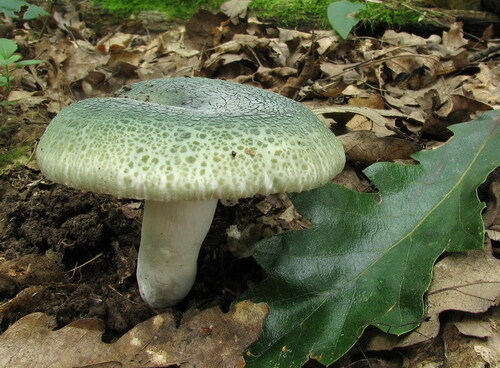
Mushroom enthusiast Antonio Carluccio described Russula virescens (Schaeff.) Fr. as "not exactly nice to look at". Its cap starts out dome or barrel-shaped, becoming convex and flattened as it ages, reaching up to 15 cm (6 in) in diameter; the center of the cap is often depressed. The cap cuticle is green, with the darkest shade at the center, and has patches of the same green arranged radially around the center in an areolate pattern. Cuticle color varies in shade, ranging from gray to verdigris to grass-green. The extent of the cuticle's patching also varies, so specimens with limited patches can resemble other green-capped Russula species, such as R. aeruginea. The green cap patches sit on a white to pale green background. While the cap is usually round, it can also have irregular lobes and cracks. The cap cuticle is thin, and can be easily peeled from the surface to about halfway toward the cap center. The gills are white to cream colored and fairly crowded; most are free and do not attach to the stipe. Veins connect gills to each other at their bases. The stipe is cylindrical, white, and grows to variable heights, reaching up to 8 cm (3 in) tall and 4 cm (1.6 in) wide; it is roughly the same thickness at both the top and base. The upper section of the stipe may be farinose, meaning it is covered with a white, mealy powder. The stipe may turn slightly brown with age, or when injured or bruised during handling. Like other mushrooms in the order Russulales, the flesh is brittle. This brittleness comes from its sphaerocyst cytoarchitecture, which consists of cylindrical cells that differ from the typical fibrous, filamentous hyphae found in other basidiomycota orders. The spores of R. virescens are elliptical or ellipsoid with warts, translucent (hyaline), and produce a white, pale or pale yellow spore print. Their dimensions are 6–9 by 5–7 μm, and a partial net-like reticulum of ridges connects the warts. The spore-bearing cells, called basidia, are club-shaped, measuring 24–33 by 6–7.5 μm; they are colorless, and each bears two to four spores. Pleurocystidia, cystidia located on the gill face, measure 40–85 by 6–8 μm and end abruptly in a sharp point. Russula virescens produces fruit bodies that grow from soil in deciduous and mixed forests. It forms ectomycorrhizal symbiotic relationships with a range of trees, including oaks (Quercus), European beech (Fagus sylvatica), and aspen (Populus tremula). Preliminary research suggests the fungus also associates with at least ten species of Dipterocarpaceae, a dominant tree family found in Southeast Asian tropical lowland forests. Fruit bodies can grow singly or in groups, return to the same locations year after year, and are not common. In Europe, fruiting occurs mainly from summer to early autumn. A Mexican study of seasonal mushroom occurrence in Xalapa's subtropical forests found that R. virescens fruits in April, before the rainy season begins. The presence of R. virescens in North America is debated, as multiple similar species including R. parvovirescens and R. crustosa are recognized there. One author suggests R. virescens is strictly a European species, citing 2006 research by Buyck and collaborators that states the virescens-crustosa group is far more complex than previously thought and includes at least a dozen taxa in the eastern United States. Like in Europe, R. virescens has a widespread distribution across Asia, and has been recorded in India, Malaysia, Korea, the Philippines, Nepal, China, Thailand, and Vietnam. It is also found in North Africa and Central America.