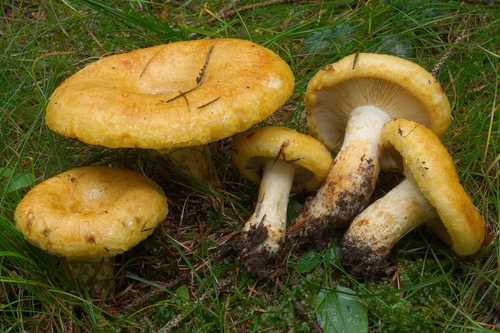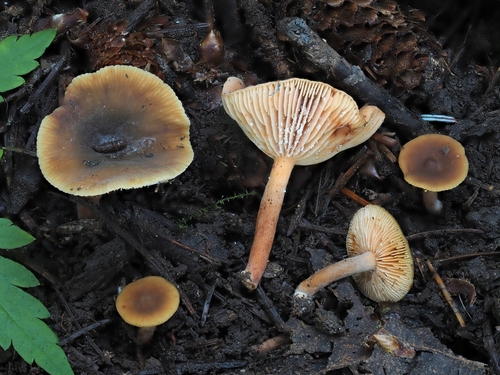
About Russula densifolia Secr. ex Gillet
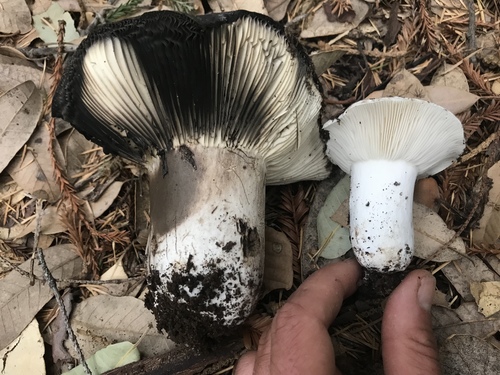
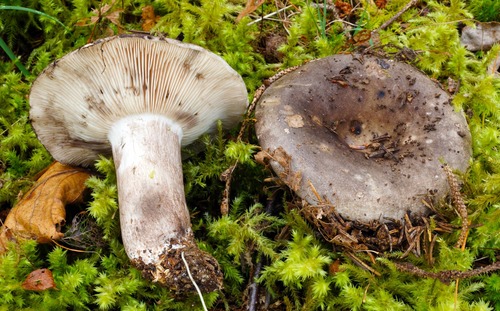
Russula densifolia Secr. ex Gillet has a cap that starts convex when young, and becomes almost flattened, depressed, or funnel-shaped when mature, reaching a diameter of 4.5–14.5 cm (1.8–5.7 in). The smooth cap surface is sticky in moist young specimens, and takes on a polished look when dry. Its color starts white, then changes to brownish gray, and eventually becomes blackish as the mushroom ages. The cap margin stays curved inward through most of the fruit body's lifespan. The cap cuticle can be peeled up to half the cap's radius. The flesh is white, and slowly turns reddish, then grayish-black after exposure to air. This staining reaction can develop slowly or not appear at all, especially in old fruit bodies where the underlying tissue has already darkened. The flesh has no distinct odor, and has a hot, bitter taste. The gills are adnate (squarely fused) to slightly decurrent (extending a short way down the stem), interspersed with many tiers of lamellulae (short gills that do not reach fully from the cap edge to the stem). Gills are very crowded, with roughly 7–12 gills per centimeter. They start creamy white, stain reddish then blackish when injured, and sometimes develop dirty reddish stains as they age. The stem measures 2–7.5 cm (0.8–3.0 in) long by 1.2–2.5 cm (0.5–1.0 in) thick, and is roughly equal in width along its whole length. It is solid (not hollow), hard, starts white, and turns brownish-black with age; its surface is dry, and ranges from smooth to slightly scaly. Russula densifolia produces a white to pale yellow spore print. Spores are oval to elliptical to roughly spherical, hyaline (translucent), amyloid, and measure 7.6–9.5 by 6.7–7.5 μm. They have a rough, reticulate surface marked by ridges and low isolated warts that are 0.2–0.5 μm high. Cystidia in the hymenium are thin-walled and hyaline, ranging in shape from club-shaped with broad tips to somewhat fuse-shaped with short narrow appendages at the tip; they measure 30–80 by 5–10 μm. Below the hymenium, the subhymenium is clearly differentiated. Abundant sphaerocysts (fragile spherical cells common to the Russulaceae) are present in the gill tissue, and cap tissue has clusters of these cells. The cap cuticle is typically 125–200 μm thick, embedded in a gelatinous layer, and divided into two layers: the epicutis made of interwoven hyphae, and the underlying subcutis. Shaffer tried to distinguish multiple forms of this mushroom based on differences in cap cuticle thickness and morphology, but these forms are no longer considered taxonomically significant. The fruit bodies of this mushroom grow on the ground singly, scattered, or in groups in both mixed and deciduous forests, and usually appear in summer and autumn. It is common in dune pine forests in Spain. Russula densifolia is widely distributed, and has been recorded from Asia (including China, India, Japan, and Thailand), Europe, and North America. A study of chronological succession of ectomycorrhizal fungal communities in Pinus densiflora forests of eastern China found that R. densifolia reaches its highest abundance in 30-year-old stands. A separate Chinese study found that the species is one of the six most common Russula species associated with 1- to 2-year-old Pinus yunnanensis seedlings. In Mexico, it has been found growing with oak. The fungus is well adapted to cold climates, because its mycelium has a relatively high tolerance to low temperatures, though repeated freezing and thawing cycles tend to slow mycelium growth. The temperature that is lethal to 50% of its mycelium is −8.6 °C (16.5 °F). Russula densifolia is a mycorrhizal species. Morphological descriptions have been published for the ectomycorrhizae it forms with European beech (Fagus sylvatica) and Norway spruce (Picea abies). Fruit bodies can be parasitized by the fungus Asterophora lycoperdoides. The mushroom is mild to moderately toxic, and may cause gastrointestinal upset if eaten. David Arora noted that most of the bitter taste can be removed with cooking, but "the end product is insipid at best and indigestible or even poisonous at worst." Even so, this mushroom is sold as an edible species in Phayao Province and Chiang Mai Province in northern Thailand. It is also used in traditional Chinese medicine for its claimed antirheumatic activity.