About Russula delica Fr.
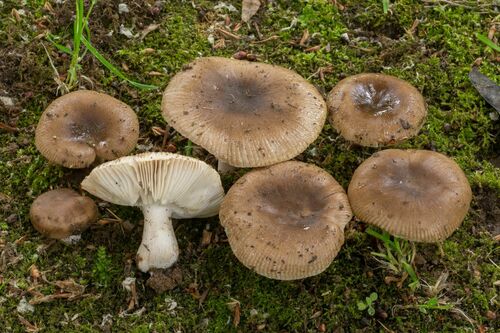
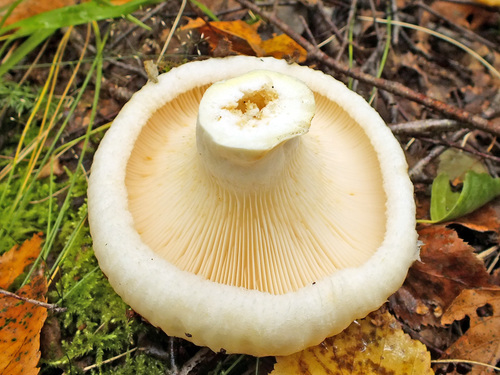
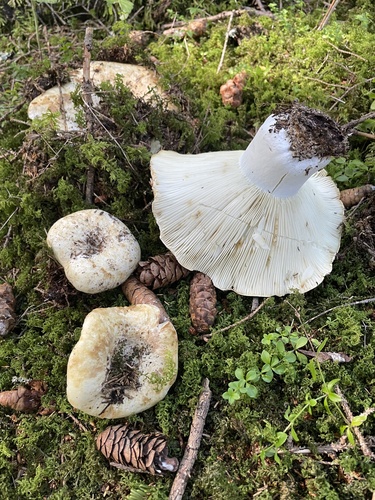
The fruiting bodies (basidiocarps) of Russula delica Fr. rarely emerge fully from the soil, and are often found half-buried, and sometimes even grow underground. Because of this growth habit, debris from surrounding leaves and soil often become trapped on the fungi's rough cap surfaces. The cap can reach 16 cm (6.3 in) in diameter. It is primarily white, usually with an ochre or brown tinge, and has an inrolled margin that typically stays white. Young caps are convex, but they flatten as they mature, and often become funnel-shaped. The stipe is firm, white, short and stout, measuring 2–6 cm (1–2.5 in) in height and 2–4 cm (1–1.5 in) in width. The gills are decurrent, and are quite closely spaced when young. This species produces a creamy white spore print. Its spores are oval, warty, and measure 8–12 x 7–9 μm. The flesh is white, and does not change color when cut. Young specimens have a pleasant, fruity odor, but mature individuals may develop a faint fishy or unpleasant smell. The taste of Russula delica is spicy and tangy. Russula delica is widely distributed across northern temperate zones, including Europe and Asia, and is particularly common in the Eastern Mediterranean. It is a thermophilic species that grows in broadleaved and coniferous woods during hot periods in summer and autumn. In North America, Russula delica is rare, and it is largely replaced by the closely similar R. brevipes, a species that does not occur in Europe.