About Russula crustosa Peck, 1887
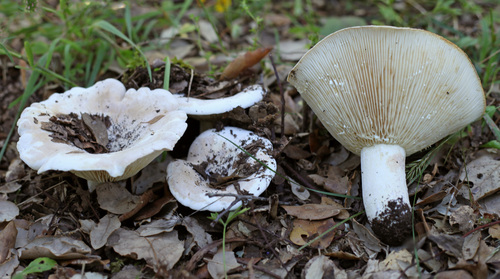
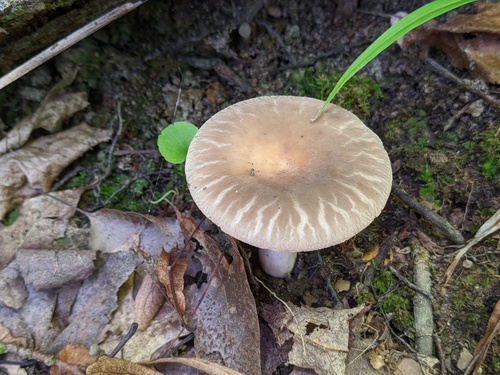
Fruit bodies of Russula crustosa have caps that are initially convex before flattening with age, often developing a central depression, and they measure 5–12.5 cm (2.0–4.9 in) in diameter. When the mushroom reaches maturity, the dry cap surface breaks up into greenish patches around the margin. The cap margin has radial grooves that align with the gills on the cap's underside. The closely spaced gills are white, cream, or pale yellow in color, and have an adnate attachment to the stem. The stem measures 3–9 cm (1.2–3.5 in) long by 1.2–2.5 cm (0.5–1.0 in) thick; it is white to pale yellow, and becomes hollow as it ages. The flesh is hard and compact when young, and it is whitish in color. The spore print is pale buff. The spores are elliptic in shape, somewhat warted with a few fine interconnecting lines; they are hyaline (translucent), amyloid, and measure 6–9 by 5.5–7 μm. This is an edible mushroom that has no distinguishing odor, and a taste that ranges from mild to slightly acrid. Other greenish species of Russula, including R. subgraminicolor, R. aeruginea, and R. variata, can be most readily distinguished from R. crustosa by their non-cracking cap surfaces. Russula crustosa is a mycorrhizal fungus that associates with broadleaf trees, particularly oak and hickory. Its fruit bodies grow on the ground in mixed forests, appearing singly, scattered, or in groups. Fruiting occurs between June and December. The pleasing fungus beetle species Tritoma angulata is known to feed on the fruit bodies of this mushroom. In North America, the mushroom is common and widespread across the southeastern United States. In Asia, Russula crustosa has been found in China, India, Malaysia, and Thailand.