About Russula atropurpurea var. bresadolae (Schulzer) Singer, 1932
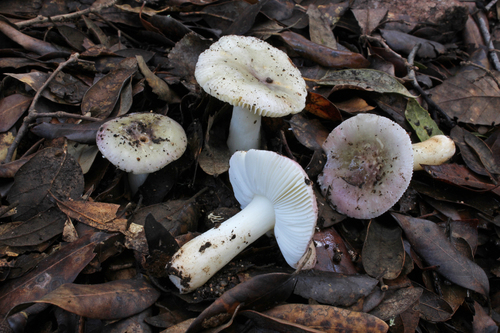
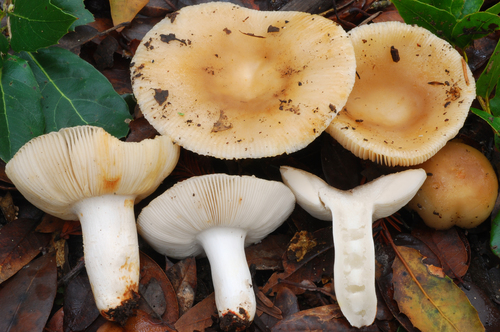
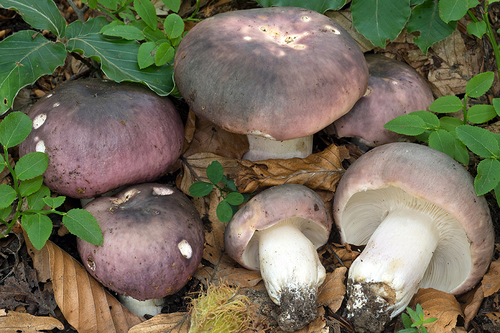
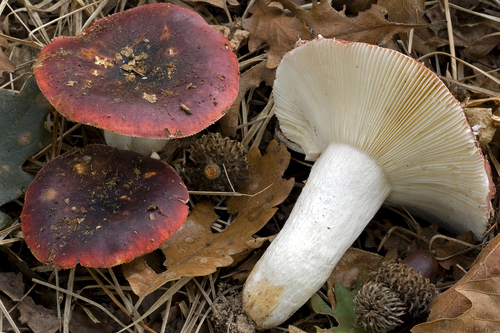
This variety, Russula atropurpurea var. bresadolae, has a cap 4 to 10 centimeters (1.5 to 4 inches) across. The cap is dark reddish purple, with a dark, sometimes almost black, center. When young, the cap is convex, but it flattens as it matures and often develops a shallow depression. Caps can also be lighter in color, or mottled with yellowish tones. As fruitbodies mature, the cap becomes concave to collect rainwater during wet weather, and much of its color washes off the cap rim.
The firm, white stem measures 3–6 cm long and 1–2 cm in diameter, and turns grey as it ages. The gills are closely spaced, fairly broad, adnexed to almost free, and pale cream; the spore print is also pale cream. The flesh is white, has a fruity odor similar to apples, and a moderately hot taste. Russula brunneviolacea and Russula romellii are similar species, though both have darker spore prints.
Russula atropurpurea grows in late summer and autumn. It is common in northern temperate zones of Europe, Asia, and Eastern North America. It forms mycorrhizal relationships, and prefers to associate with oak (Quercus). It favors acidic soil, and is occasionally found growing with beech (Fagus) or pine (Pinus).