About Rusa timorensis (Blainville, 1822)
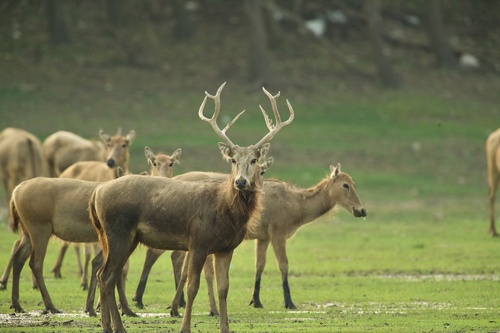
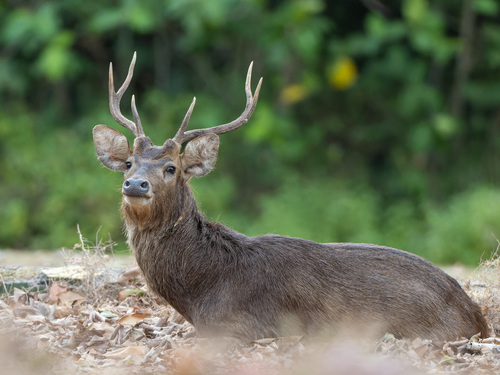
The Javan rusa, scientifically named Rusa timorensis (Blainville, 1822), has the following physical characteristics. Its body is dark blackish brown, with a gray forehead, an almost black back, yellowish brown underparts and inner thighs, lighter brown abdomen, and a dark blackish brown tail tuft. Its hair is coarse, and hair on the chest is longer than hair on the rest of its body. It has wide ears that are slightly shorter than the length of its head. Its antlers are medium in length and quite wide, with the upper branch pointing forward. Newborn fawns have no spots. Males are larger than females. The species has a total head-to-body length ranging from 142 to 185 cm (4 ft 8 in to 6 ft 1 in), with a tail that measures 20 cm (7.9 in). Males weigh between 152 and 160 kg (335–353 lb), while females weigh approximately 74 kg (163 lb).
Javan rusa are native to the Indonesian islands of Java, Bali, and Timor. They have been introduced to Irian Jaya, Borneo, the Lesser Sunda Islands, Maluku, Sulawesi, Pohnpei, Mauritius, Réunion, Fiji, Tonga, Samoa, Vanuatu, the Solomon Islands, Christmas Island, the Cocos Islands, Nauru, Groote Eylandt, Mainland Australia, New Caledonia, New Zealand, Papua New Guinea, New Britain, and New Ireland. The Dutch introduced Javan rusa to New Guinea in the early 1900s. After its introduction to the West Papuan lowlands, the species has become widely dispersed and is common across most of its new introduced range. In contrast, the Javan rusa population in its native range has declined sharply by approximately 10,000 individuals over the past two decades, and is expected to decline further. Because of this, the species is listed as vulnerable within its native range, and was designated a protected species under Indonesian law in 2018. In the 1980s and 1990s, protected areas including national parks were established to manage threats from poaching and land conversion that destroyed grazing habitats. Despite this, large numbers of Javan rusa died in Indonesia's Baluran National Park after invasive thorny acacia eliminated their grazing areas.
Javan rusa are primarily nocturnal, though they also graze during the day. They are rarely found in open areas and are very hard to approach, due to their sharp senses and cautious behavior. They are most often found in small groups or pairs, but males are frequently seen alone. When alarmed, a male rusa stag emits an extremely loud honk as an alarm call to warn other nearby deer. Like other deer species, Javan rusa feed mainly on grass, leaves, and fallen fruit. They get most of the water they need from the food they eat, so they rarely drink standing water.
Javan rusa mate around July and August. During this time, male stags compete for mates by calling with a loud, shrill bark and dueling with their antlers. Female does give birth to one or two calves after an 8-month gestation period, which occurs at the start of spring. Calves are weaned between 6 and 8 months after birth, and reach sexual maturity between 3 and 5 years of age, depending on habitat conditions. Javan rusa live between 15 and 20 years in both the wild and captivity.