About Ruppia cirrhosa (Petagna) Grande
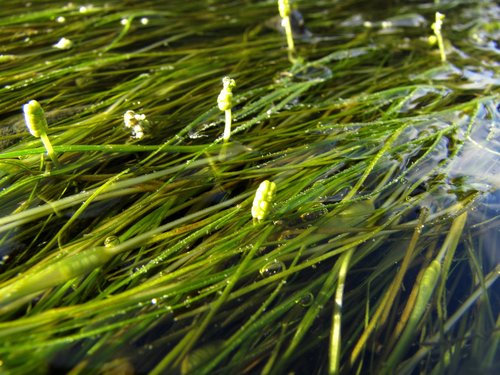
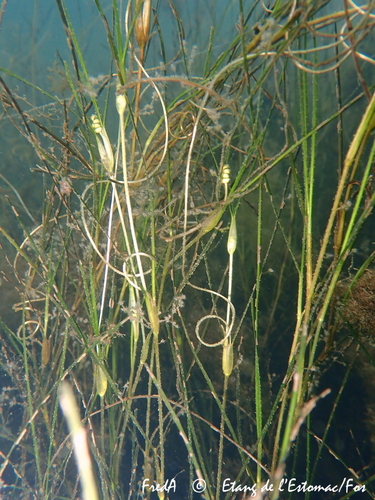
Spiral tasselweed (scientific name Ruppia cirrhosa (Petagna) Grande) is a perennial aquatic plant. It grows from a monopodial rhizome, and produces slender, delicate stems up to around 0.6 m long each year, with many long branches. All of its leaves are identical, and typically grow entirely submerged; leaf blades reach up to around 120 mm long by about 1 mm wide. Leaf tips are minutely serrated and quite blunt. Leaf sheaths can be up to 25 mm long, open along one side and papery (hyaline) along the other, and there is no ligule. Inflorescences grow singly from leaf axils, inside the distinctively inflated sheaths of involucral leaves. Each inflorescence holds two flowers positioned close together at the tip of a stalk called a peduncle, which can grow up to 300 mm long. Each flower has two two-lobed stamens, giving the appearance of four yellow, round anthers. At the center of this group of four anthers is a cluster of 2 to 8 carpels, which grow on very short stalks that lengthen as the fruit matures, eventually reaching around 32 mm in length. In spiral tasselweed, the peduncle often becomes coiled once fruit matures; even when it does not coil, it is usually at least twice as long as the individual fruit stalks, and can sometimes be up to ten times as long. Flowers typically sit at the water surface, where pollen is dispersed by water currents, or are raised into the air, where they can be wind-pollinated. Mature fruits are flask-shaped, up to around 3.5 mm long, and brown or grey, with tiny reddish warts on their surface. Their outline is almost symmetrical, which distinguishes them from the irregularly shaped fruits of beaked tasselweed. Great care is required to identify different species of tasselweed. In north-west Europe, including Ireland and Britain, there are only two wild tasselweed species: spiral tasselweed and beaked tasselweed. Only spiral tasselweed produces a coiled peduncle, though this coiling is rarely seen. The relative lengths of the peduncle and fruit stalks are a more reliable identification feature: spiral tasselweed has peduncles up to 4 cm long, which are longer than its fruit stalks that reach up to 3.2 cm, while beaked tasselweed has peduncles up to 2.6 cm long, which are shorter than its fruit stalks that reach up to 3.5 cm. Most sources state that spiral tasselweed has a cosmopolitan, circumpolar distribution, though this claim is debated. It generally grows only in brackish to saline coastal locations, but North American plants sometimes classified as R. occidentalis grow in freshwater inland lakes. The IUCN has assessed its global conservation status as LC (least concern), meaning there is no evidence of a serious global decline. However, it is rare in some countries and regions, and holds local conservation statuses: it is listed as VU (vulnerable) in Brittany, extinct in lower Normandy, and NT (near threatened) in Britain. For conservation purposes, spiral tasselweed is generally considered an axiophyte, meaning it acts as an indicator of good environmental conditions. Evidence suggests its presence increases invertebrate diversity and improves the nutritional quality of substrate in coastal lagoons. Although spiral tasselweed often grows alone, it is occasionally found growing alongside other plants such as the eelgrasses Zostera marina and Z. noltii, for example at The Fleet in Dorset. Within the British National Vegetation Classification, it is probably restricted to the SM2 Ruppia maritima community, though significant confusion between the two tasselweed species existed in the 1980s, and the description of SM2 would benefit from revision. Most sources agree that spiral tasselweed is strictly coastal, but not a marine plant. Its Ellenberg values in Britain are L = 7, F = 12, R = 7, N = 4, and S = 4, which reflect its habitat requirements: it grows in waterbodies in reasonably sunny locations with neutral soils, low fertility, and brackish conditions. The only recorded organism associated with this species in Europe, and probably in Britain, where it has been found on R. maritima possibly including R. cirrhosa, is the cercozoan Tetramyxa parasitica, which forms spherical galls in the stems of infested plants.