About Rupicola rupicola (Linnaeus, 1766)
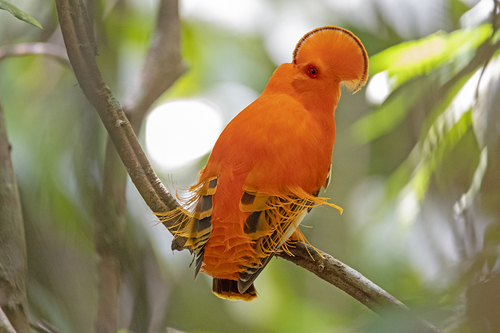
The Guianan cock-of-the-rock, with the scientific name Rupicola rupicola (Linnaeus, 1766), is a stout-bodied bird distinguished by a prominent half-moon crest. This species is sexually dimorphic: the male has a more pronounced, bright orange crest than the female. Males also have a black tail tipped with orange, wings marked with black, orange, and white, a bright orange bill, an orange iris that yellows toward its outer edge, and silky-orange filamentous feathers on the inner remiges. Both sexes have orange legs and orange skin. The less noticeable female is overall dark brownish-grey, with a black bill tipped with yellow, a duller orange iris, and a smaller crest. One-year-old juvenile males resemble adult females but have orange speckles across their bodies. After two years, juvenile males are mostly orange with brown and grey spots, and males reach their full definitive plumage at around three years old. Juvenile females look almost identical to adult females. Guianan cocks-of-the-rock are approximately 30 cm (12 in) in total length, and weigh around 200 to 220 g (7.1 to 7.8 oz). The two existing cock-of-the-rock species are allopatric, meaning they do not encounter one another. Compared to the Guianan cock-of-the-rock, male Andean cocks-of-the-rock have redder plumage and mostly black wings that lack the orange colouration found on male Guianan cocks-of-the-rock. Female Andean cocks-of-the-rock are reddish brown, while female Guianan cocks-of-the-rock are brownish-grey. As its common name suggests, the Guianan cock-of-the-rock is native to the Guianan Shield, where it occurs in French Guiana, Suriname, Guyana, southern Venezuela, eastern Colombia, and northern Amazonian Brazil. It prefers humid forest habitats located near rocky outcrops, and is typically found at altitudes between 300 and 2,000 m (980 and 6,560 ft). Guianan cocks-of-the-rock have distinctive territorial markings. Males usually hold territory on the ground, though they sometimes occupy the forest's middle strata. They create their marked territories by clearing debris including twigs, leaves, and pellets from the ground; this cleared area is called a "court". Court quality is known to influence female mate choice. Court quality is determined by territory density and the court's location relative to the center of activity in the lek. This focus on the lek's activity center exists because successful males typically hold courts in the most densely clustered areas of the lek. Guianan courts are commonly found in the Guianan Shield, a forested region in northeastern South America.